
Yatai: Japan’s food stalls, from Edo’s fire rules to Fukuoka’s licensed street kitchens
I have not been to every place in this guide. The figures below are taken from the sources listed at the end, with the date each one was published — not measured by me. Where I have been, the article says so.
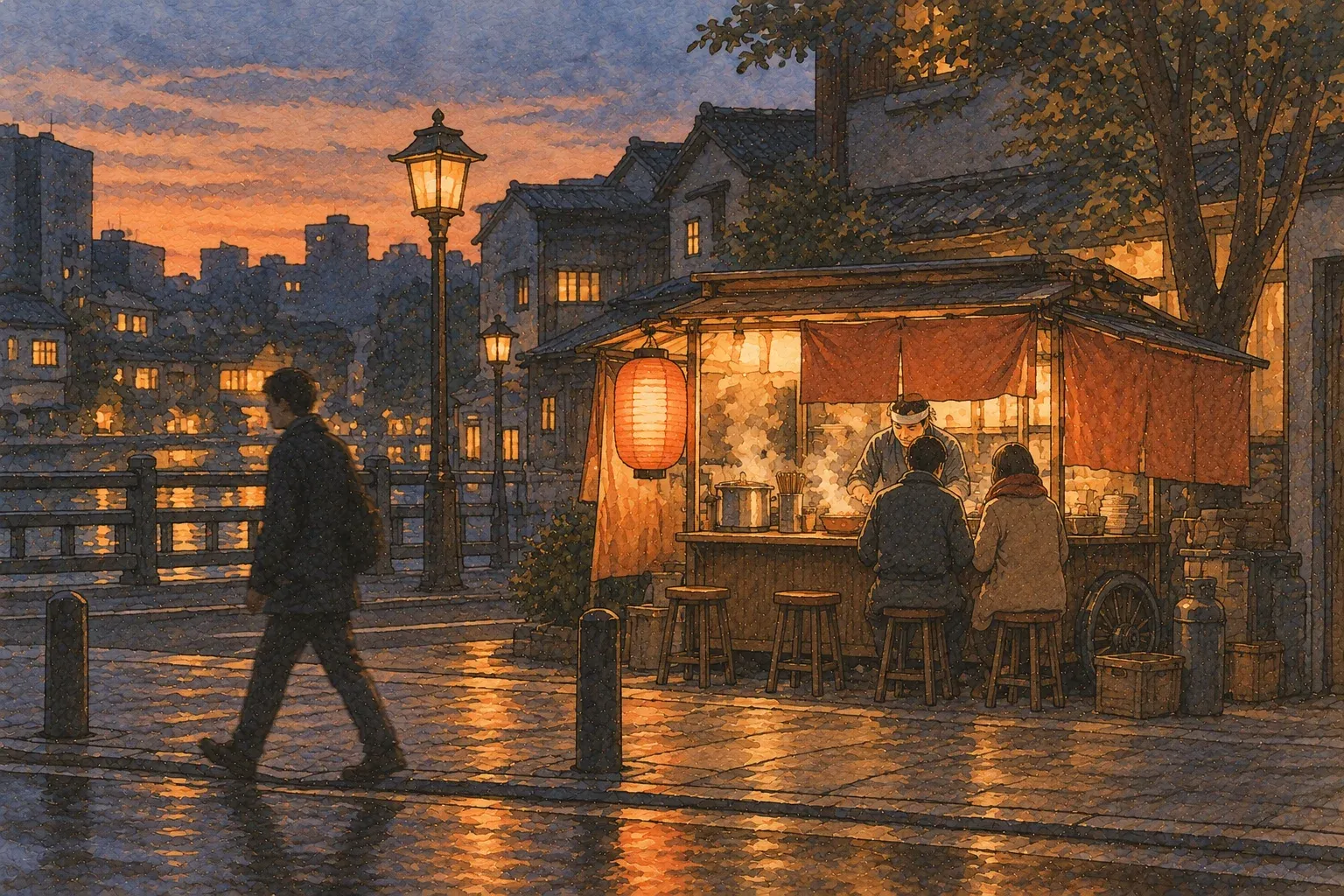
Yatai is usually translated as “food stall”, and it covers three quite different things. In Fukuoka it is a cart that sets up on the same pavement every night, licensed under a city ordinance. At a shrine festival it is a stall assembled for a day or a weekend. And there are kitchen cars that cook on board and move around. They share a long history — Edo’s street food — and a set of permits that explain much of what they sell. This page is the map; the lineage pages cover Fukuoka’s stalls and festival stalls.
What it is
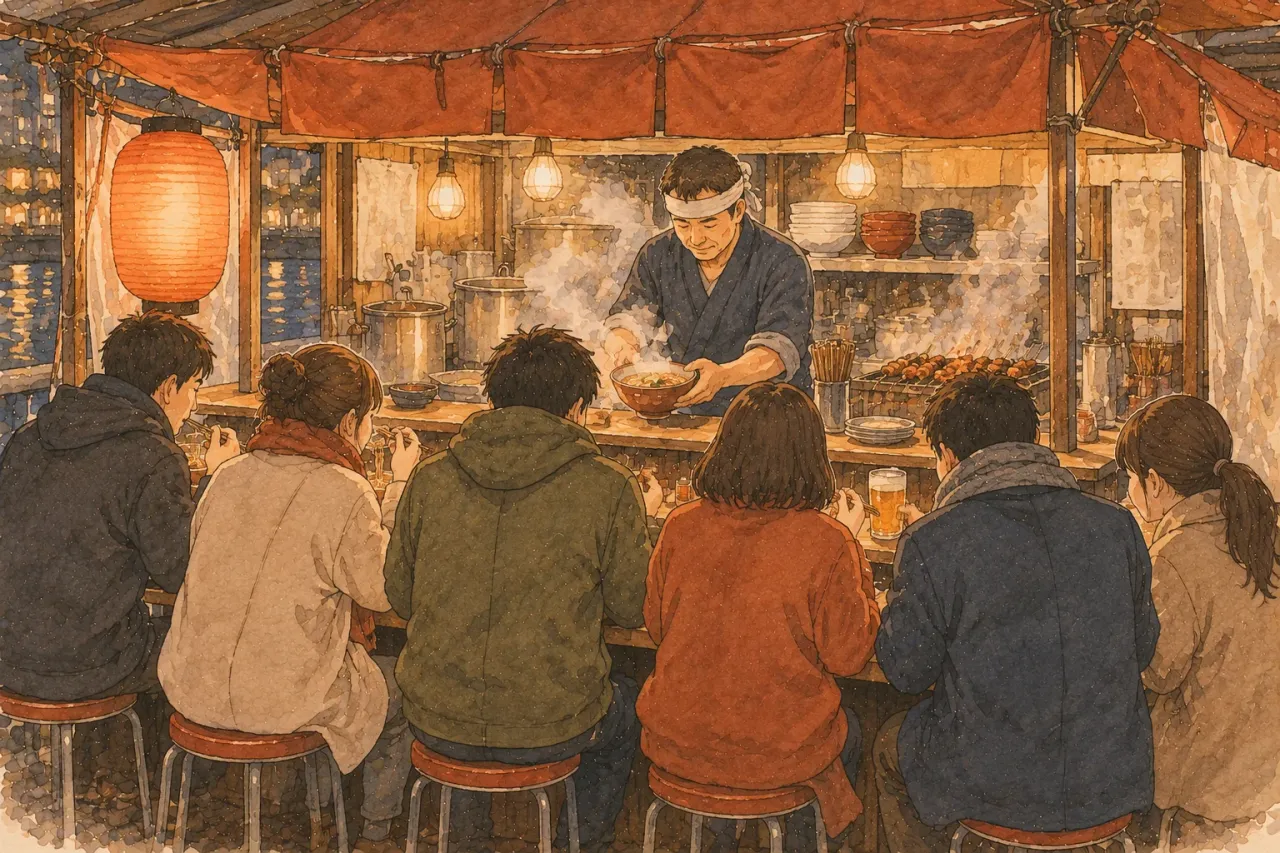
- Fukuoka’s yatai. The city’s ordinance defines a yatai as a light vehicle (under the Road Transport Vehicle Act) fitted with equipment for a restaurant business, and yatai business as setting it up at a fixed place for fixed hours.
- Festival stalls (roten). Osaka city describes them as stalls assembled each time they trade.
- Mobile trading. Tokyo classes trading from a vehicle while moving around as mobile restaurant business; Fukuoka licenses kitchen cars, which cook inside a vehicle, as restaurant business (vehicle).
I found no official source that sorts Japan’s food stalls into these types as a whole; the list above puts the cities’ descriptions side by side.
The permits
- Food. Since 1 June 2021, Japan’s Food Sanitation Act has a revised permit system and a new notification system; businesses outside the permit categories generally notify the health centre. The health ministry says the aim, with HACCP-based hygiene now required, is to know who the food businesses are.
- In Osaka, stalls that cook and serve food need a restaurant permit; a permit obtained in Osaka prefecture since June 2021 is valid across the prefecture. HACCP-style hygiene and a food hygiene supervisor are required.
- What a stall may sell, in Osaka. In principle, food simple to prepare on site and heated just before serving — oden, takoyaki, fried chicken, shūmai. Shaved ice, warabi-mochi and drinks are exceptions. Raw food (sashimi, salad), cutting after cooking, and preparation such as chopping vegetables or cleaning fish on site are not allowed. Other cities may differ.
- The road. Setting up a stall on a road without moving needs a road-use permit from the police (category 3), and sometimes a road-occupancy permit as well, the National Police Agency says.
- Local festivals. In Osaka, a festival run by a neighbourhood association, children’s group or school, held temporarily (in principle up to about five times a year), not mainly for profit, with stalls run by the organiser or people it chooses, can file a temporary notice instead of getting a permit, and receives hygiene guidance. Trading as a business needs a permit. That is Osaka’s practice; I have not confirmed it nationally.
Where it came from: Edo
- Fire rules. Reference answers from the National Diet Library cite histories of Edo food: those who cooked with fire and oil, like tempura sellers, were allowed to trade only outdoors for fear of fire. Stalls had no wheels; they were set down, and folded away when a lord’s procession passed. A 1686 order banned moving sales of udon, soba and other foods cooked on fire (trading in one place was allowed, with care), and a 1699 town order said the same, adding that cooked-food selling should stop on windy days. Night trading in cooked food was banned in 1661, and trading after 6 p.m. in 1670 — though one source notes the basis for the hour is unclear.
- The stall era. Kikkoman’s food culture research centre says stall shops appeared in the An’ei era (1770s) and by the Tenmei era (1780s) lined both sides of streets — suggesting the repeated bans on selling food from carried fires were not obeyed. They sold simmered vegetables, tempura, grilled eel, sushi, barley rice, oden, grilled dumplings and sweet rice cakes. For people in back-alley tenements, the street stall was the main way of eating out, and for single people and small households cheaper and easier than buying firewood to cook.
- Tempura was one of those stall foods, says the farm ministry: in a new city like Edo, standing to eat at a stall became common, helped by the invention of the shichirin charcoal stove.
- Nigiri sushi. Its origin is not settled. The library’s answer says the period is broadly agreed — around 1820 — with one source placing it near the east end of Ryōgoku bridge, one saying it began at stall shops, and another suggesting “Matsu-ga-sushi” in Fukagawa early in the Bunka era.
The lineages
The table is kept in one place so that every kind is described on the same terms. Rows without a link are on the list but not written yet.
| Lineage | Origin | What it is | The rules | What it sells | Worth knowing |
|---|---|---|---|---|---|
| Fukuoka yatai 博多・福岡の屋台 | Fukuoka cityc. 1946; ordinance 2013 | A cart set up at the same place every night on a street or in a park | Road-use, road-occupancy and restaurant permits; a city ordinance since 2013; new pitches by public competition since 2016 | Pork-bone ramen, yakitori, oden; no raw food | About 100 stalls; few seats; mostly cash; at least one drink and one dish each |
| Festival stalls (roten) 祭り・縁日の露店 | Nationwidestalls in Edo from the 1770s | Stalls assembled for each festival or fair | Restaurant permit, or a temporary notice by a local organiser; road-use permit on streets | Simple food heated just before serving, such as takoyaki, karaage, oden (Osaka's rules) | Run by travelling traders known as tekiya or yashi |
| Kitchen carsキッチンカー | Nationwide— | Vehicles that cook on board | Restaurant permit (vehicle); in Fukuoka valid six years, city-wide | — | — |
Lineages without a link are on the list but not written yet. The table is kept in one place so every lineage is described on the same terms.
Where to find them
- Fukuoka — about 100 licensed street stalls in Nakasu, Tenjin and Nagahama.
- Festivals — shrine and temple fairs across Japan.
The same word, a different stall
No official source compares Fukuoka’s stalls with “stall-style” restaurants or tourist stalls in Tokyo or Osaka, so this page does not. What the rules show is that they are different businesses: Fukuoka’s are permanent, nightly, on public land, under a city ordinance; festival stalls are assembled for an event and, in Osaka at least, limited to simple heated food.
What people get wrong
- “Yatai are unregulated.” They need food, road-use and often road-occupancy permits; Fukuoka has its own ordinance.
- “Street food is a modern idea in Japan.” Edo had rows of food stalls by the 1780s.
- “Festival stalls can sell anything.” In Osaka, only simple food heated before serving, with a few exceptions.
- “All yatai are the same.” A Fukuoka cart, a festival stall and a kitchen car are licensed differently.
Questions people ask
What is a yatai?
The word covers several things. Fukuoka's ordinance defines a yatai as a light vehicle fitted for a restaurant business and set up at a fixed place for fixed hours. Osaka describes festival stalls as stalls assembled each time. Kitchen cars that cook on board are licensed separately.
Do food stalls need a licence?
Yes. Cooking and selling food needs a restaurant business permit under the Food Sanitation Act. A stall on a road needs a road-use permit from the police, and sometimes a road-occupancy permit too. Small local festivals in Osaka can instead file a temporary notice with the health centre.
Why do festival stalls sell takoyaki and karaage?
In Osaka the rules allow stalls to sell food that is simple to prepare on site and heated just before serving, such as oden, takoyaki, fried chicken and shūmai. Raw food such as sashimi or salad is not allowed.
Sources
Prices are in Japanese yen. Conversions are approximate, at ¥177.30 to the euro and ¥158.23 to the US dollar as of 20 Oct 2026. Rates come from the European Central Bank, which publishes on working days only. Prices checked Oct 2026. What food costs in Japan →