
Fukuoka’s yatai: how about 100 street stalls survive under Japan’s first stall ordinance
I have not been to every place in this guide. The figures below are taken from the sources listed at the end, with the date each one was published — not measured by me. Where I have been, the article says so.
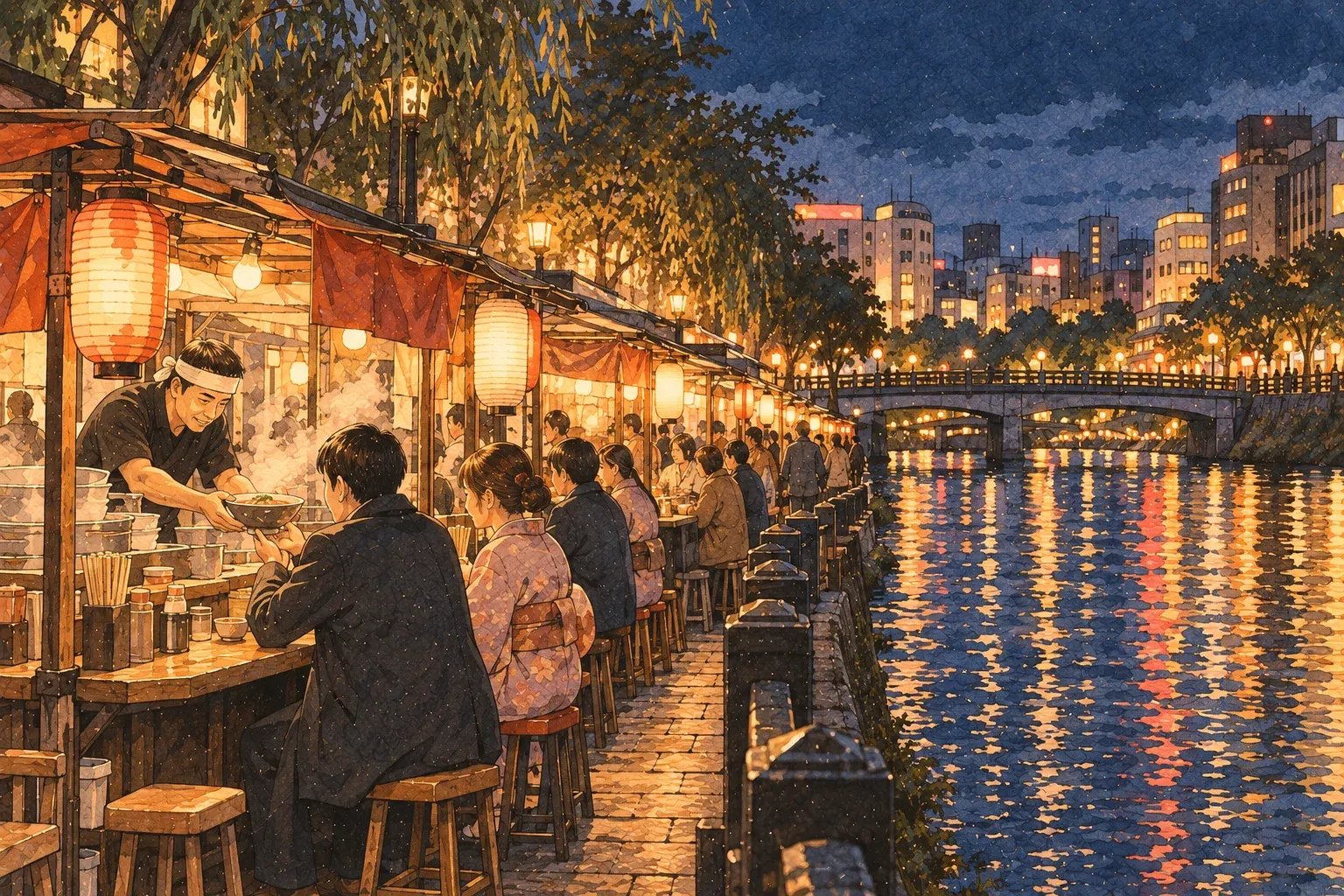
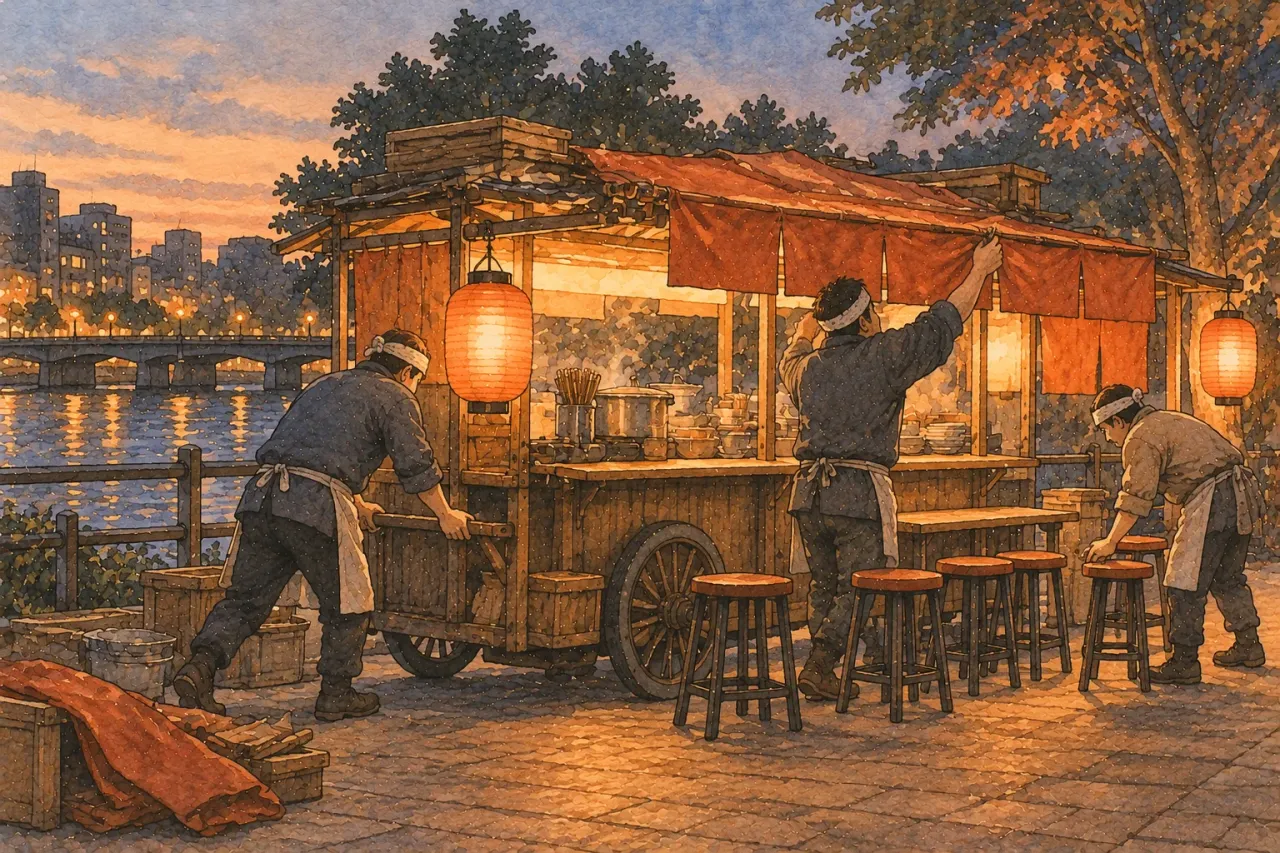
Fukuoka is the city of yatai: carts that roll out onto pavements and into parks every evening, serve ramen, yakitori and oden to a few people at a time, and are gone by morning. They nearly disappeared. A policy that let a licence pass only to a direct heir shrank their number by three quarters; an ordinance in 2013 and public competitions from 2016 brought in new operators. This page covers the rules, the history, and how to use one. Ramen at the stalls is covered on the Hakata ramen page.
For food stalls in general, start from the yatai overview.
Where it came from
The city’s timelines and articles agree on the outline, and differ on some numbers:
- After the war. Around 1946, in the confusion after the war, stalls began trading on roads from makeshift structures. The city’s tourism site says they are thought to have begun in the black markets.
- The peak. In the Shōwa 40s (the late 1960s) there were more than 400. The city’s tourism site says the peak was well over 400 and today’s number is about a quarter of it.
- The Olympics. The same site says that before the 1964 Tokyo Olympics the government tried to restrict stalls on hygiene and safety grounds, and Fukuoka’s operators lobbied successfully to keep them. That is the only source I found for this episode.
- One generation only. In 1995, with about 220 stalls, the prefectural police chief told the assembly that new entrants would in principle not be allowed. Under the “one generation” policy, a stall could pass only to a spouse or a child who was a direct heir and lived mainly on its income; numbers could only fall. A city timeline gives about 150 by 2010; a contributed article gives 190 in 2000 and 155 in 2010. The figures differ by source.
- Rethinking. A 2000 guideline moved to licensing under road-occupancy permits; in 2011 the mayor announced a review, a study group reported in 2012, and the ordinance was passed in July 2013. The article lists the problems behind it: stalls that would not relocate, complaints about dirt and smell, criticism of private profit on public land — and the contradiction of a tourist asset that might vanish.
How the rules work
The ordinance. Fukuoka’s basic ordinance on yatai took effect on 1 September 2013; the city calls it Japan’s first. Its stated aim is to use the stalls’ benefits while regulating them, to keep public space safe and pleasant and hygiene good, so that they coexist with the city. It sets duties for the city, operators and customers.
- Three permits for a stall on a city road: road occupancy, road use and restaurant business. In a park: park occupancy and restaurant business. Road occupancy lasts up to a year; park occupancy six months.
- Hours are set as a condition of the permit, not in the ordinance itself.
- Space. A stall must leave at least 2 m of pavement clear and stay at least 0.6 m from tactile paving for blind people.
- The operator must run the stall in person, and may not transfer, sublet or pledge it; must report changes, breaks of a month or more, and closure; must use the water, drainage and power points the city installs; and must keep to the law, serve safely, consider residents and join in cleaning. The city’s newsletter adds clear price display and keeping the road clean.
Public competition. The ordinance lets the mayor designate pitches and invite applicants (individuals, not companies) when a stall would create liveliness and serve as a tourist resource. Competitions began in 2016. The city says five rounds have created 56 stalls, of which 44 were trading in October 2025. The fifth round offered six pitches (three in Watanabe-dōri, two in Tenjin-higashi, one in Nagahama) and drew 61 applicants, a record 10.17 to one; the winners opened from April 2025. In May 2025 the city counted about 100 stalls, more than four in ten of them chosen by competition. The scheme won a Good Design Award in 2025.
How to use one
From the city’s tourism site:
- Hours. Some open at 18:00, most around 18:30–19:00, closing around midnight. No fixed holidays; some close in rain or storms. Very few take bookings.
- Seats. Few — up to about ten — and best for two or three. No toilets; leave luggage in lockers or at your hotel.
- Ordering. Say how many you are; queue at the back if there is a line. Check prices before ordering. At least one drink and one dish each. Say when you are done to pay. Don’t stay long — try about three stalls.
- Charges. Most have no otoshi or table charge; bar-style stalls may.
- Paying. Mostly cash; about 10% take credit cards (a 2023 article says more are taking cards and electronic payment).
- Food. Pork-bone ramen, yakitori, oden; yaki-ramen (fried ramen) is popular. No stall serves raw food.
- Where. Nakasu and Tenjin, and Nagahama, where new stalls have been added.
What it costs
The city’s tourism site has published menu prices in articles, but without stating tax and with a note that they may have changed, so I do not reproduce them. I found no official guide to what an evening at a stall costs. The Hakata ramen page gives the bowl prices three stalls listed in 2026.
Fukuoka’s yatai and stalls elsewhere
- The rules are Fukuoka’s own. Permanent, nightly stalls on public land, under an ordinance, with water and power supplied by the city — a different business from a festival stall assembled for a weekend.
- Tokyo’s mobile carts. Tokyo’s health bureau advises people trading from carts to move to fixed shops or vehicles. I found no official count of Fukuoka-style stalls elsewhere.
- No comparison of taste or price with “stall-style” restaurants in other cities exists in official sources, so this page makes none.
What people get wrong
- “Yatai are a free-for-all.” They need three permits on a road, and operators must run their own stall.
- “They are dying out.” They fell from over 400 to about 100, but competitions since 2016 have created 56 new stalls.
- “Stalls charge a cover.” Most do not; some bar-style ones do.
- “You can linger all night.” The city’s own advice is to move on.
Questions people ask
How many yatai are there in Fukuoka?
About 100, according to the city's newsletter of May 2025, more than four in ten of them new stalls chosen by public competition. At the peak in the 1960s there were over 400.
Do Fukuoka yatai charge a cover?
Most do not, according to the city's tourism site, though bar-style stalls may. Order at least one drink and one dish per person, and check prices before ordering.
Can I pay by card at a yatai?
Sometimes. The city's tourism site says most are cash only and about one in ten take credit cards, while a 2023 city article says more are accepting cards and electronic payment. Bring cash.
When are yatai open?
Most open around 18:30–19:00, some from 18:00, and close around midnight. There are no fixed holidays, and some close in rain or storms.
Sources
Prices are in Japanese yen. Conversions are approximate, at ¥177.30 to the euro and ¥158.23 to the US dollar as of 20 Oct 2026. Rates come from the European Central Bank, which publishes on working days only. Prices checked Oct 2026. What food costs in Japan →