
Unagi: why eel costs what it does, what the grades mean, and the summer day Japan eats it
I have not been to every place in this guide. The figures below are taken from the sources listed at the end, with the date each one was published — not measured by me. Where I have been, the article says so.
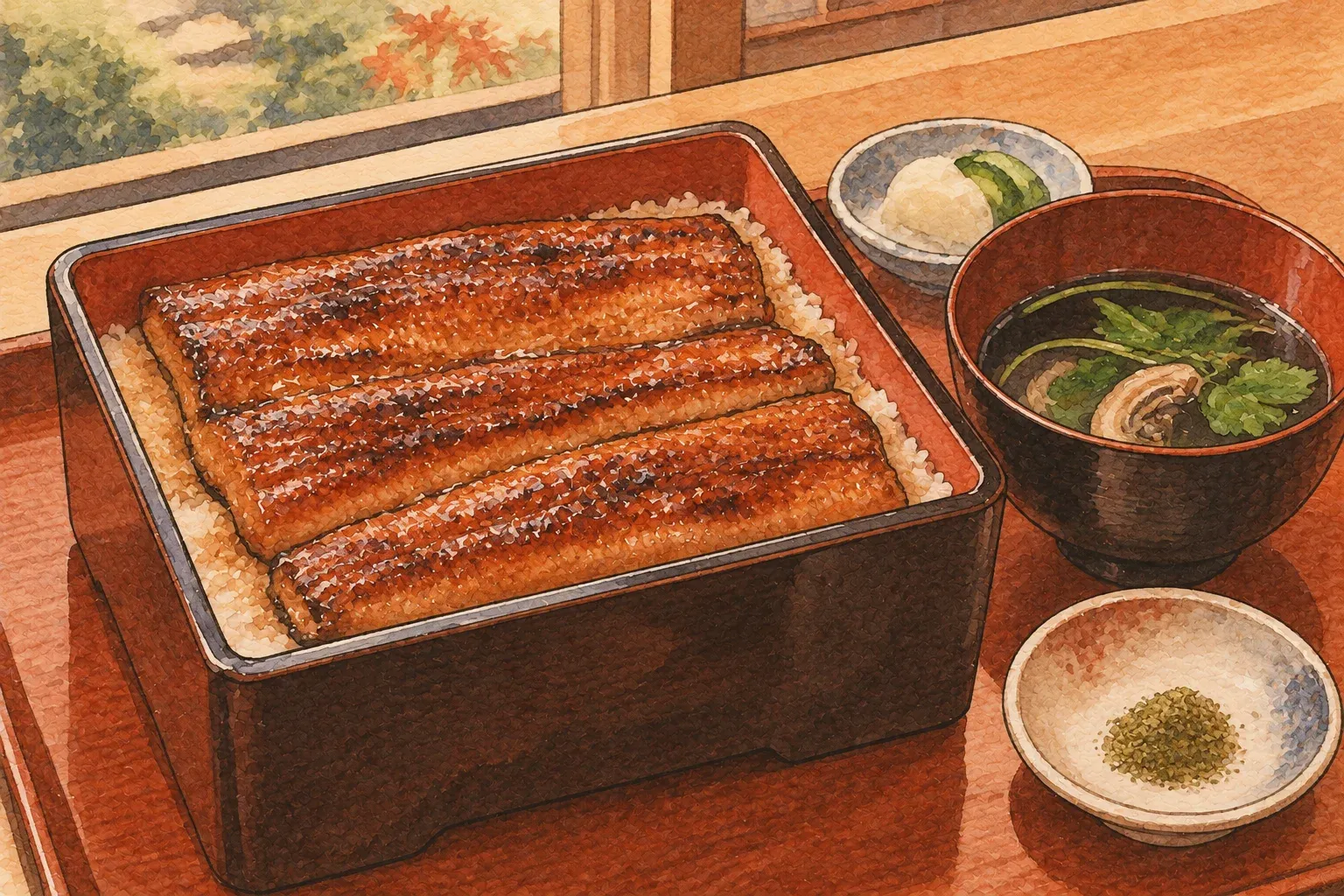
Grilled eel (kabayaki) on rice is one of the most expensive everyday dishes in Japan, and one of the least understood by visitors. The price has a cause you can trace back to a fish 0.2 grams in weight. The grade names on the menu — ume, take, matsu — sound like a national system and are not. And the reason a whole country queues for eel on one summer day is an argument historians have not settled. This page is the map. The lineage pages cover the two ways of cooking it: Kantō, opened along the back and steamed, and Kansai, opened along the belly and grilled straight.
What it is
Freshwater eel, opened, skewered and grilled over charcoal with a sweet soy tare, usually served on rice. The fisheries agency counts 19 species and subspecies of eel worldwide, four widely eaten; almost all eel farmed in Japan is the Japanese eel, while imports include American eel in recent years.
The Japanese eel’s life is still partly a mystery. It hatches near the Mariana Islands, about 2,000 km from Japan, drifts towards East Asia as a larva and then a transparent glass eel, spends 5–15 years in rivers and estuaries, and is thought to return to the Marianas to spawn. Its spawning ground was only pinpointed in 2011, 36 years after research began.
The way it is served came from takeaway. The farm ministry says eel and rice were originally separate; the donburi spread because putting eel on hot rice kept it warm for delivery, and the lacquered box (jū) at first held only eel.
Season. The farm ministry’s sources do not agree. One says wild eel has two seasons, summer when it feeds and autumn to winter when it goes down to the sea, and farmed eel is at its best in early summer; another says the true season is autumn, when it fattens before winter. Both are official; take your pick.
Why it costs what it does
Every eel starts wild. Farms raise glass eels — about 6 cm and 0.2 g — caught in the wild. The catch fell steeply from the late 1950s and has mostly been 5–30 tonnes a year since the early 1980s. Over 20,000 people catch them, a few grams each a day.
The seed price swings. The fisheries agency’s industry figures for the average glass eel price (domestic and imported) run from ¥160,000 a kilo in 2003 to a peak of ¥2.99 million in 2018, ¥2.5 million in 2024, ¥1.3 million in 2025 and ¥660,000 in the 2026 season, the second fall in a row. At about 5,000 glass eels to a kilo, ¥1.3 million a kilo is roughly ¥260 per eel before it has eaten anything — my arithmetic, not an official figure — and it is then fed for six months to over a year. In Hamamatsu a 0.2 g glass eel grows to 200–300 g in a year or more.
Ponds are capped. Since a 2014 joint statement, Japan, China, South Korea and Taiwan limit how many young eels go into farm ponds, 20% below the previous level. For the 2026 season Japan’s quota is 21.7 tonnes of Japanese eel across 507 licensed farms.
Most eel is imported. In 2025, on the fisheries agency’s live-weight basis, Japan produced 17,611 t (17,557 farmed, 54 caught) and imported 45,987 t: about 72% imported by my calculation. And “domestic” farming uses some imported glass eels, so domestic does not mean Japanese from birth. Supply peaked at 158,094 t in 2000 and has been around 60,000 t in recent years. Kagoshima farms the most (7,342 t), then Aichi, Miyazaki and Shizuoka.
The price has already risen. The statistics bureau’s comparison of 2007 and 2017: the quantity households bought fell to 54% of the earlier level, the consumer price index for kabayaki rose to 183, and real spending fell to 41%.
The protection question
The IUCN Red List classed the Japanese eel as Endangered in 2014 (the European eel was already Critically Endangered). The European eel has been under CITES Appendix II since 2009, and the EU issues no export permits. At CITES COP20 in 2025, the EU and Panama proposed listing all eel species; the committee rejected it by 100 votes to 35, with 8 abstentions, and a resolution on eel trade and management was adopted by consensus. Expert opinions on the proposal were split — these figures come from the Japanese government’s own summary, which should be read with that in mind. From December 2025 glass eels fall under Japan’s law against illegally caught seafood, after the agency found a 1.2-tonne gap between what was reported caught and imported and what went into ponds.
The day of the ox
Doyō is the roughly 18 days before each of the four seasonal turning points. The zodiac day of the ox comes round every 12 days, so some summers have two ox days in doyō, ichi no ushi and ni no ushi. In the 2017 household survey, households spent ¥390 on kabayaki on the first ox day and ¥65 on the second — far more than on any other day — and July accounted for 37.3% of the year’s spending.
Why eel? The explanations, all recorded, none proven:
- Hiraga Gennai, the Edo polymath, is said to have told a struggling eel shop to post “Today is the day of the ox”. The statistics bureau and the farm ministry call it the famous theory; a food company’s history page says there is no firm evidence.
- Harukiya, an Edo eel shop, is said to have found that eel grilled on the ox day kept better than on other days — a story quoted from an old essay as folk tradition.
- Folk wisdom: eating nourishing eel on the hottest days to avoid summer fatigue.
- A sales ploy that made sense: a standard encyclopedia calls it an eel-shop tactic, reasonable as summer nutrition, already practised in the 1820s.
The grades, and what it costs
Unaju (eel) うな重
- Chains
- ¥1,060Unaju, basic grade · Unatoto · tax incl. · checked 2026-10-05
- Our guide figure
- from ¥2,500 (≈ €14 / $16)Eel is the one everyday dish that is genuinely expensive in Japan · Oct 2026
The figures above are kept on the price reference page and update there. On any eel menu you will meet grade words — ume, take, matsu (plum, bamboo, pine), or nami, jō, tokujō (standard, superior, extra). There is no common rule. Each shop decides. Three examples, all tax included:
- Unagi no Naruse (chain), as announced in August 2024: ume, take and matsu were half, three-quarters and a whole eel; prices ran ¥1,600–2,600 for the leaner nami eel, ¥1,900–2,900 for jō, ¥3,400–4,400 for tokujō (five a day). Its current site gives ¥1,900, ¥2,500 and ¥2,900 without stating tax.
- Unagi Edogawa (Nara): take, one eel, ¥4,400; matsu, one and a quarter, ¥5,450.
- Atsuta Hōraiken head shop (Nagoya): eel bowl ¥3,300 for three pieces, jō ¥4,100 for four, tokujō ¥5,700 for six; hitsumabushi ¥4,950. Its eel kaiseki is ¥12,100 at lunch and ¥16,500 at dinner, plus a 10% service charge.
So at one shop the grade is the amount, at another the quality of the eel, at a third the number of pieces. Ask.
Where else. On the ox day, the farm ministry notes, eel is sold in quantity at supermarkets and convenience stores as well as eel shops.
How to order and eat it
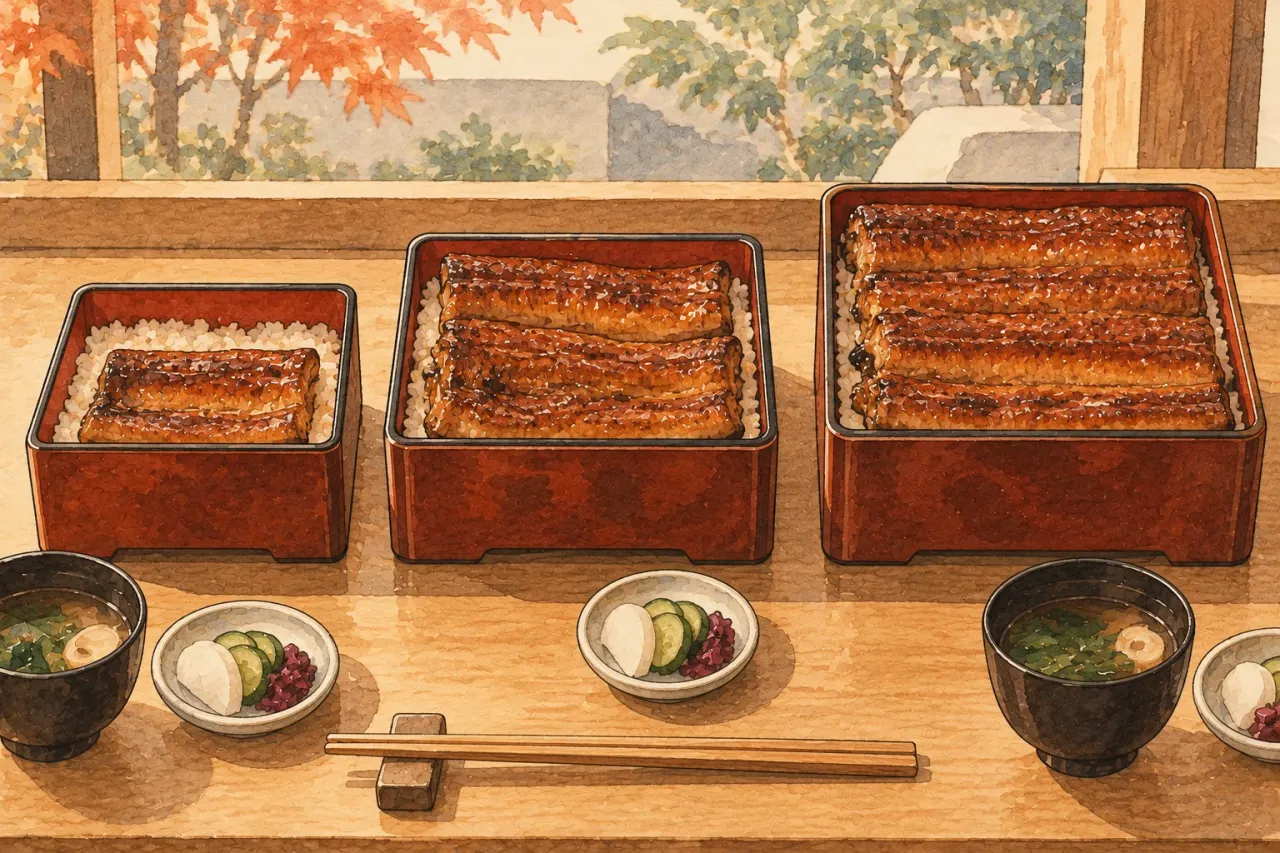
- The forms. Unajū (in a box) and unadon (in a bowl) are eel on rice; kabayaki is the eel alone; shirayaki is grilled without tare, eaten with wasabi and soy. Tokyo’s tourism site says unajū usually comes in about three sizes.
- On the side. Eel-liver soup (kimosui), vinegared eel with cucumber (uzaku), eel rolled in omelette (umaki).
- Sanshō. The ground pepper on the table was, the farm ministry says, originally to mask the smell of farmed eel in the old days. A Nihonbashi shop quoted by Tokyo’s tourism site advises tasting the eel first and adding a little.
- Small bones. There are some. Eat carefully.
- Always cooked. Eel blood is toxic, the farm ministry says, but heat — 60°C for five minutes or more — destroys it.
- Eel and pickled plum. The old warning against eating them together has no medical basis.
The lineages
The table is kept in one place so that every style is described on the same terms. Rows without a link are on the list but not written yet.
| Lineage | Origin | How it is opened | How it is cooked | What you notice | How it is eaten |
|---|---|---|---|---|---|
| Kantō style 関東式(背開き・蒸し) | Edo (Tokyo)steaming said to date from the Bunsei era (1818–30) | Along the back | Grilled plain, steamed, then grilled again with tare over charcoal | Soft; steaming takes out excess fat | Unajū in a lacquer box, with liver soup; sanshō pepper after the first bite |
| Kansai style (jiyaki) 関西式(腹開き・地焼き) | Kyoto / Osakakabayaki from the Genroku era in Kyoto | Along the belly | Grilled over charcoal with tare, no steaming | Crisp, fragrant skin | Called mamushi in Kansai; in Nagoya, hitsumabushi eaten in three ways |
| Yanagawa seiro-mushi柳川のせいろ蒸し | Yanagawa, Fukuoka— | — | Steamed in a basket over rice | — | — |
Lineages without a link are on the list but not written yet. The table is kept in one place so every lineage is described on the same terms.
Hamamatsu, on Lake Hamana, sits between the two: the city says that because it is halfway between Tokyo and Osaka you can eat both styles there. Eel farming there began with Hattori Kurajirō in the Meiji era, more than 120 years ago.
Where to eat it
- Tokyo — the Kantō style; Nihonbashi has old shops that publish their method.
- Osaka — jiyaki, belly-opened and unsteamed.
- Nagoya — hitsumabushi at Atsuta Hōraiken, founded 1873.
- Hamamatsu — both styles; the city with the highest household kabayaki spending in the 2015–17 survey.
- Yanagawa, Fukuoka — seiro-mushi, eel steamed on rice in a basket, a Cultural Agency “100-year food”, about 30 shops.
Check fares and journey times with the operator before you travel.
The same eel, a different city
- The famous towns are not the biggest farms. Shizuoka, home of Hamamatsu, was fourth in 2025 with 1,827 t; Kagoshima farmed four times as much. Yanagawa’s shops use farmed eel from Kagoshima and Miyazaki, because wild eel is no longer caught there. An Osaka jiyaki shop buys from Lake Hamana, Mikawa Isshiki, Kōchi, Kagoshima, Shizuoka, Tokushima and Miyazaki.
- The spending map is western. In the 2015–17 household survey (the latest that breaks out kabayaki), Hamamatsu spent most per household, ¥6,311, then Kyoto, Ōtsu, Nara and Osaka; central Tokyo was ¥3,352, national ¥2,617. That is shop-bought eel, not restaurants.
- What the region gives you is a style. Hamamatsu offers both; Osaka grills without steaming; Nagoya serves hitsumabushi; Yanagawa steams in a basket. The price and size of a box, meanwhile, depend more on the type of shop — chain, specialist, kaiseki — than on the town.
What people get wrong
- “Japanese eel is Japanese.” About 72% of supply is imported, and some domestically farmed eel began as imported glass eels.
- “Eel is farmed from eggs.” Farms raise wild-caught glass eels.
- “Matsu is always the best.” The grades mean what the shop says: size, quality or piece count.
- “Gennai invented the day of the ox.” That is the famous story; it is not proven, and other explanations exist.
- “Hamamatsu farms the most eel.” Kagoshima does.
- “Kantō and Kansai style are fixed by region.” They are the typical patterns. Nara’s Unagi Edogawa opens along the back and steams.
Questions people ask
Why is unagi so expensive?
Every farmed eel starts as a glass eel caught in the wild, about 0.2 g each, and the catch is unstable. Glass eels have traded at between ¥660,000 and ¥2.99 million a kilo in recent seasons, Japan caps how many may go into farm ponds, and about seven in ten eels eaten in Japan are imported.
What do ume, take and matsu mean on an eel menu?
Whatever the shop decides. At one chain they meant half, three-quarters and a whole eel. At a Nara shop take is one eel and matsu one and a quarter. At Atsuta Hōraiken in Nagoya the grades of eel bowl count the pieces. There is no shared rule.
When is the day of the ox?
Doyō is the roughly 18 days before each change of season. The day of the ox recurs every 12 days, so the summer doyō has one or sometimes two ox days, called ichi no ushi and ni no ushi. That is when Japan buys most eel.
Is Japanese eel endangered?
The IUCN Red List placed it in the Endangered category in 2014. A 2025 proposal to list all eel species under CITES Appendix II was rejected. Japan, China, South Korea and Taiwan agreed in 2014 to cut the number of young eels put into farm ponds by 20%.
Sources
Prices are in Japanese yen. Conversions are approximate, at ¥177.30 to the euro and ¥158.23 to the US dollar as of 20 Oct 2026. Rates come from the European Central Bank, which publishes on working days only. Prices checked Oct 2026. What food costs in Japan →