
Kantō-style eel: opened along the back, steamed, then grilled — and the three explanations for why
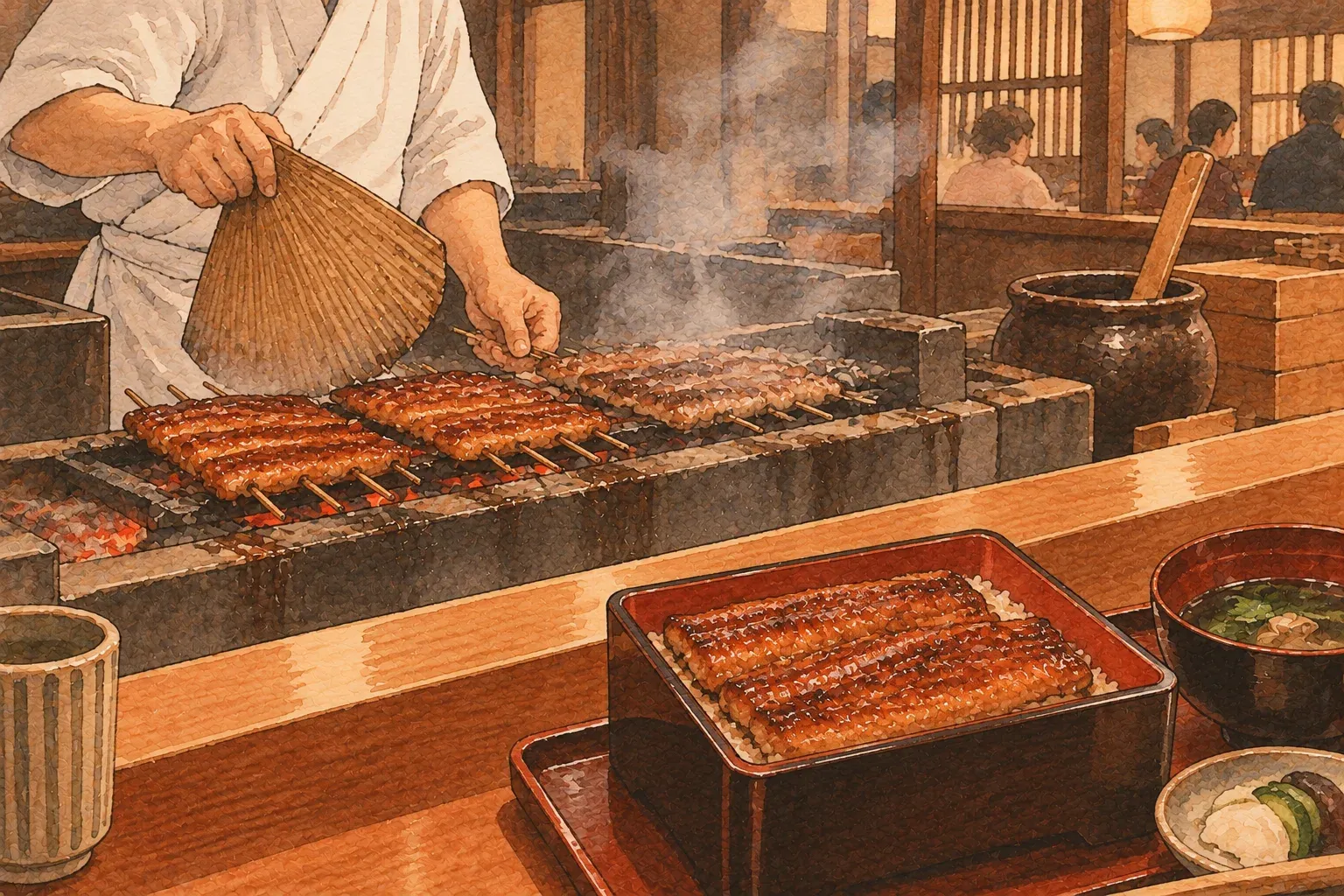
I have not been to every place in this guide. The figures below are taken from the sources listed at the end, with the date each one was published — not measured by me. Where I have been, the article says so.
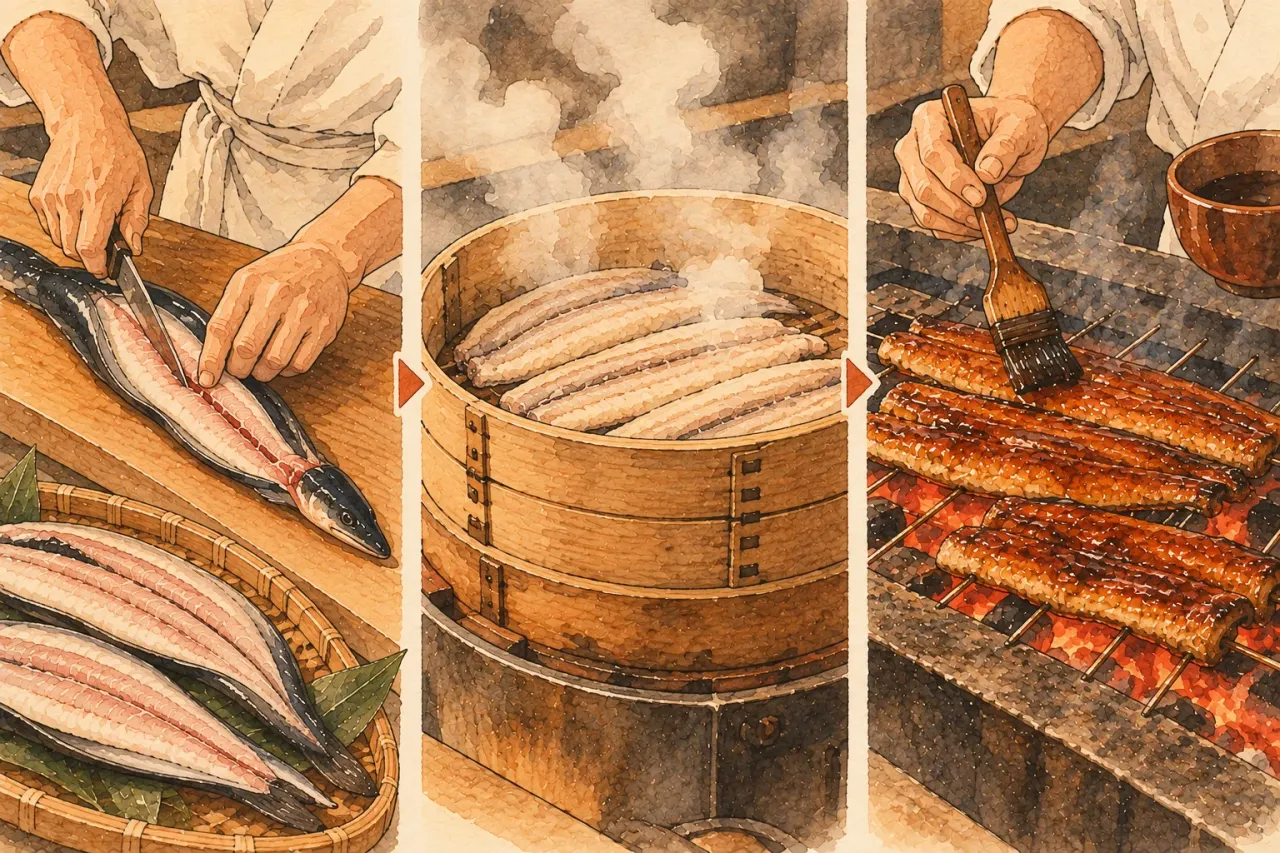
In Tokyo an eel is opened along the back, skewered, grilled plain, steamed, and only then grilled with tare over charcoal. The result is soft: the steaming, in the research accounts, takes out fat and tenderises the flesh. It is a longer process than the Kansai way, and the extra step — the steaming — is the whole difference. It also comes with an argument about why Tokyo cuts from the back that is worth knowing, because the most famous answer is the least supported.
For eel in general — prices, grades, the day of the ox — start from the unagi overview.
Where it came from
The Kikkoman food culture research centre’s journal gives the sequence. Kabayaki was born in Kyoto around the Genroku era and reached Edo in the early 18th century. At first Edo cooked it the Kyoto way. But grilled straight, the eel was fatty and the flesh tough, so Edo added a step: grill it plain (shirayaki), steam it, then grill it with tare. The steaming is said to date from the Bunsei era (1818–30). It drops the excess fat, softens the flesh, and takes out the muddy smell of Kantō river fish.
Older still: a food company’s history cites a late-Muromachi cookbook that mentions kabayaki, when the eel seems to have been skewered whole, unopened, and an 18th-century encyclopedia describing it split and skewered. The farm ministry gives three theories for the name kabayaki: the skewered round pieces looked like the head of a bulrush (gama); the colour and shape resembled birch (kaba) bark; or it comes from kabaya, “the smell arrives quickly”. It does not choose.
The tare. The farm ministry says eel was first seasoned with salt, then soy sauce as soy spread, and later a tare of soy, sugar and mirin. The Kikkoman journal says sake was added to soy first, then mirin, which improved flavour, aroma and gloss. A food company links the spread of the soy-and-mirin tare to mirin production growing in Nagareyama, Chiba.
Edomae. The phrase meant eel before it meant sushi. The farm ministry and the Kikkoman journal both say it referred to eel caught near the mouth of the Ōkawa — the Sumida river — in front of Edo. Eel from elsewhere was tabi-unagi (travelling eel) or Edo-ushiro (behind Edo). The name now survives mostly on nigiri sushi.
Why the back
Three explanations, from official and research sources, which this site leaves side by side:
- Samurai superstition. In a city of samurai, cutting the belly recalled seppuku, ritual suicide, and was unlucky. The farm ministry’s magazine, Kyoto’s tourism site and Tokyo’s tourism site all repeat this.
- Not proven. A food company’s history says there is no firm evidence for the samurai-versus-merchant explanation, and that seeing the back cut as a technique for steaming is more realistic.
- The skewers. The Kikkoman journal argues that steaming needs three or four skewers per eel, and that skewers sit better in an eel opened from the back; the change from Kansai’s belly cut and single skewer to Edo’s back cut and four skewers came with the steaming technique.
What makes it Kantō style
The farm ministry’s method: open along the back, remove bone and guts, skewer, grill plain, steam, then grill over charcoal while brushing with tare. Two shops that publish their process:
- Nihonbashi Izumoya, founded 1946: plain grill, steam, grill with tare. It says late in the day some dishes sell out, recommends booking early, and asks for some dishes to be ordered the day before.
- Unagi Edogawa, in Nara: back-opened, plain grill, steam, final grill — a Kantō method in the Kansai region.
The shops, and what they charge
Unaju (eel) うな重
- Chains
- ¥1,060Unaju, basic grade · Unatoto · tax incl. · checked 2026-10-05
- Our guide figure
- from ¥2,500 (≈ €14 / $16)Eel is the one everyday dish that is genuinely expensive in Japan · Oct 2026
The figures above are kept on the price reference page and update there. Tax-included examples:
- Unagi Edogawa: take (one eel) ¥4,400; matsu (one and a quarter) ¥5,450; kabayaki or shirayaki, one eel ¥4,200, half ¥2,100.
- Unagi no Naruse, a chain, in its August 2024 announcement: half, three-quarters and a whole eel as ume, take, matsu, from ¥1,600 to ¥4,400 depending on the eel grade.
Izumoya’s prices are not given here.
How to eat it
- Unajū is eel on rice in a box; Tokyo’s tourism site says it usually comes in about three sizes. Kabayaki alone is eel without rice; shirayaki is grilled without tare and eaten with wasabi and soy.
- Sanshō — taste first, then a little, the Nihonbashi shop in Tokyo’s guide advises; the aroma is strong.
- Kimosui, eel-liver soup, is the usual side. Uzaku and umaki are common starters.
- Mind the bones. There are small ones.
Not all of Japan’s eel is this
- Kansai opens the eel along the belly and grills it without steaming, for a crisp skin. See the Kansai page.
- Nagoya serves hitsumabushi, chopped eel on rice eaten in three ways.
- Yanagawa steams eel on rice in a basket.
Eating it in Tokyo, and getting there
Nihonbashi has old eel shops that publish their methods. Check fares and journey times with the operator before you travel.
Kantō eel away from Tokyo
- The method travels; the region does not decide it. Nara’s Unagi Edogawa steams; Hamamatsu, by its city’s account, serves both styles because it lies halfway between Tokyo and Osaka.
- Tokyo is not the big spender. In the 2015–17 household survey, central Tokyo households spent ¥3,352 a year on shop-bought kabayaki, against ¥6,311 in Hamamatsu and ¥4,224 in Kyoto.
- The eel comes from elsewhere. Edomae eel is long gone; farmed eel in 2025 came mostly from Kagoshima, Aichi, Miyazaki and Shizuoka, and about 72% of supply was imported.
What people get wrong
- “The back cut is because of seppuku.” That is the best-known explanation and is unproven. A technique for steaming is the other candidate.
- “Kantō eel has always been steamed.” Edo first grilled it the Kyoto way; steaming came later, said to be in the Bunsei era.
- “Edomae means sushi.” It meant eel first.
- “Only Tokyo steams eel.” Shops in the Kansai region do too.
Questions people ask
Why is Tokyo eel opened along the back?
There are three explanations. The best known is that in a samurai city, cutting the belly recalled ritual suicide. A food company's history says there is no firm evidence for that. A Kikkoman research journal argues that steaming needs three or four skewers, which suit an eel opened from the back.
Why is Kantō eel steamed?
According to a Kikkoman research journal, the Kansai method left Edo's eel fatty and tough, so a steaming step was added after a first plain grilling, said to date from the Bunsei era (1818–30). Steaming drops excess fat, softens the flesh and removes the muddy smell of river fish.
What did Edomae originally mean?
Eel. It meant eel caught near the mouth of the Sumida river, in front of Edo. Eel from elsewhere was called tabi-unagi, travelling eel. The word now survives mainly as a name for nigiri sushi.
Sources
Prices are in Japanese yen. Conversions are approximate, at ¥177.30 to the euro and ¥158.23 to the US dollar as of 20 Oct 2026. Rates come from the European Central Bank, which publishes on working days only. Prices checked Oct 2026. What food costs in Japan →