
Kansai-style eel: opened along the belly, grilled without steaming, and Nagoya’s hitsumabushi
I have not been to every place in this guide. The figures below are taken from the sources listed at the end, with the date each one was published — not measured by me. Where I have been, the article says so.
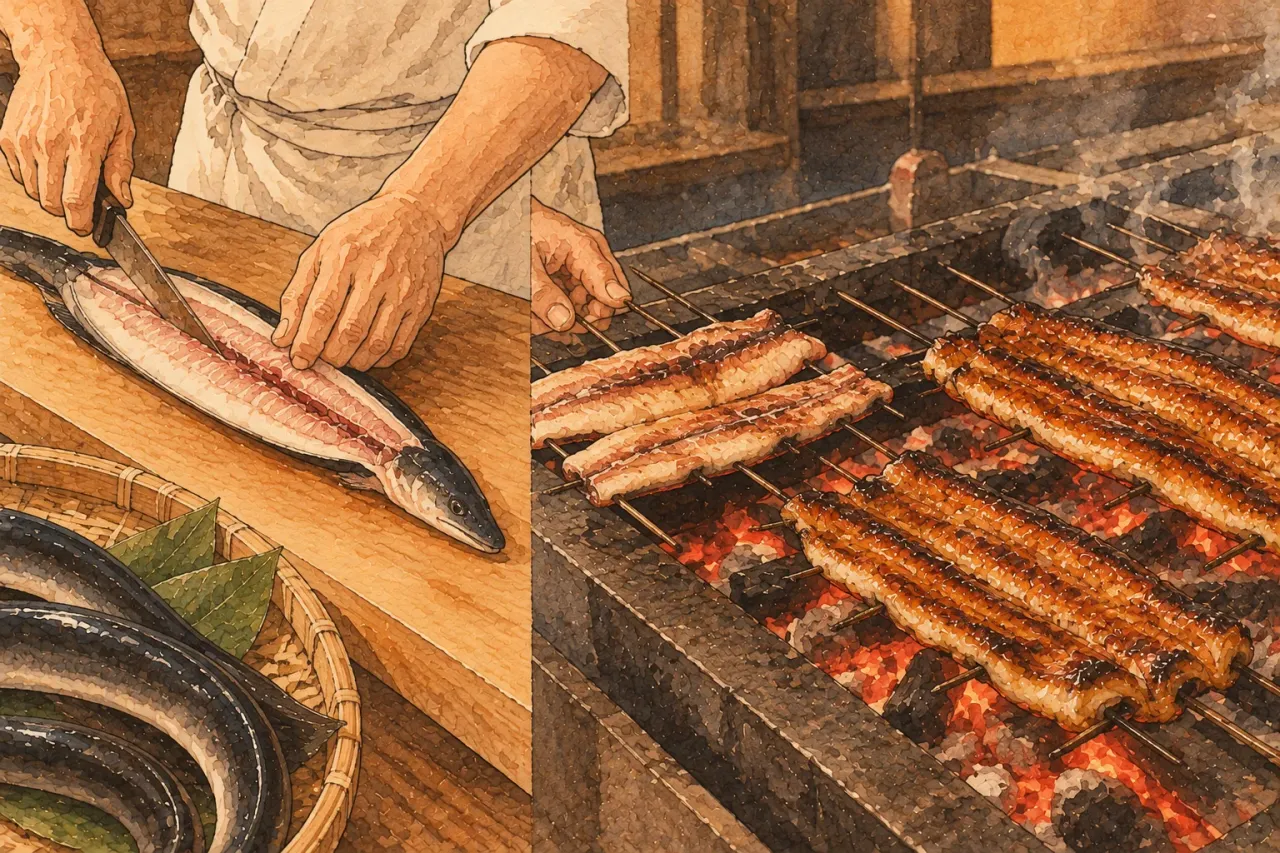
Kansai eel skips the step that defines Tokyo’s. The eel is opened along the belly, skewered, and grilled over charcoal while being brushed with tare — no steaming. Tokyo’s tourism site describes the result as fragrant, crisp-skinned eel. In Osaka the eel is even grilled with the head on. This page covers that method, the explanations for the belly cut, and Nagoya’s hitsumabushi, the best-known eel dish of the region between.
For eel in general — prices, grades, the day of the ox — start from the unagi overview.
Where it came from
The Kikkoman food culture research centre’s journal says kabayaki was born in Kyoto around the Genroku era, and that Edo first cooked it the same way before adding steaming. Kyoto’s tourism site says the belly cut was devised first in Kansai, and that while Kantō steams, Kansai normally finishes by grilling alone.
A second story for the belly cut. The farm ministry’s entry on Shimane’s eel tofu records a different route. In 1756 eels were suddenly abundant in the Nakaumi lagoon; merchants of Matsue began selling them in Osaka, carrying them along the Izumo road — the “eel road”. The belly-cut culture, it says, is said to have reached Osaka with that trade, and eel shops named Izumoya multiplied there. That is a separate explanation from Edo’s back-cut stories, and this site does not choose between them.
Mamushi. Kyoto’s tourism site notes that calling kabayaki mamushi is Kansai usage. The farm ministry’s magazine says the word is said to come from ma-mushi, “steamed between”: grilled eel tucked between layers of rice so it steams.
What makes it Kansai style
The farm ministry’s method: open along the belly, remove bone and guts, skewer, and grill over charcoal while brushing with tare, without steaming.
Head on, in Osaka. The ministry’s Osaka entry says the eel is opened from the belly with the head still attached, grilled with tare, and the head cut off at the end. The heads, called hansuke, are simmered with tofu as hansuke-dōfu. Two stories for the name: a basket of heads cost 50 sen, half of one yen (ensuke), or a man called Hansuke sold them.
One shop’s account. An Osaka eel shop and live-eel wholesaler founded in 1867 explains Osaka jiyaki as belly-opened and grilled without steaming; it grills over binchōtan charcoal, turning many times, and rests the skewered eel in the fridge for four to five hours first. It buys from Lake Hamana, Mikawa Isshiki, Kōchi, Kagoshima, Shizuoka’s Yoshida, Tokushima and Miyazaki. I could not find an official definition of the word jiyaki.
Not a rule. Tokyo’s tourism site notes that some specialists now use both methods, and Nara’s Unagi Edogawa opens along the back and steams. “Kansai means belly cut, no steaming” is the typical pattern, not a law.
Nagoya’s hitsumabushi
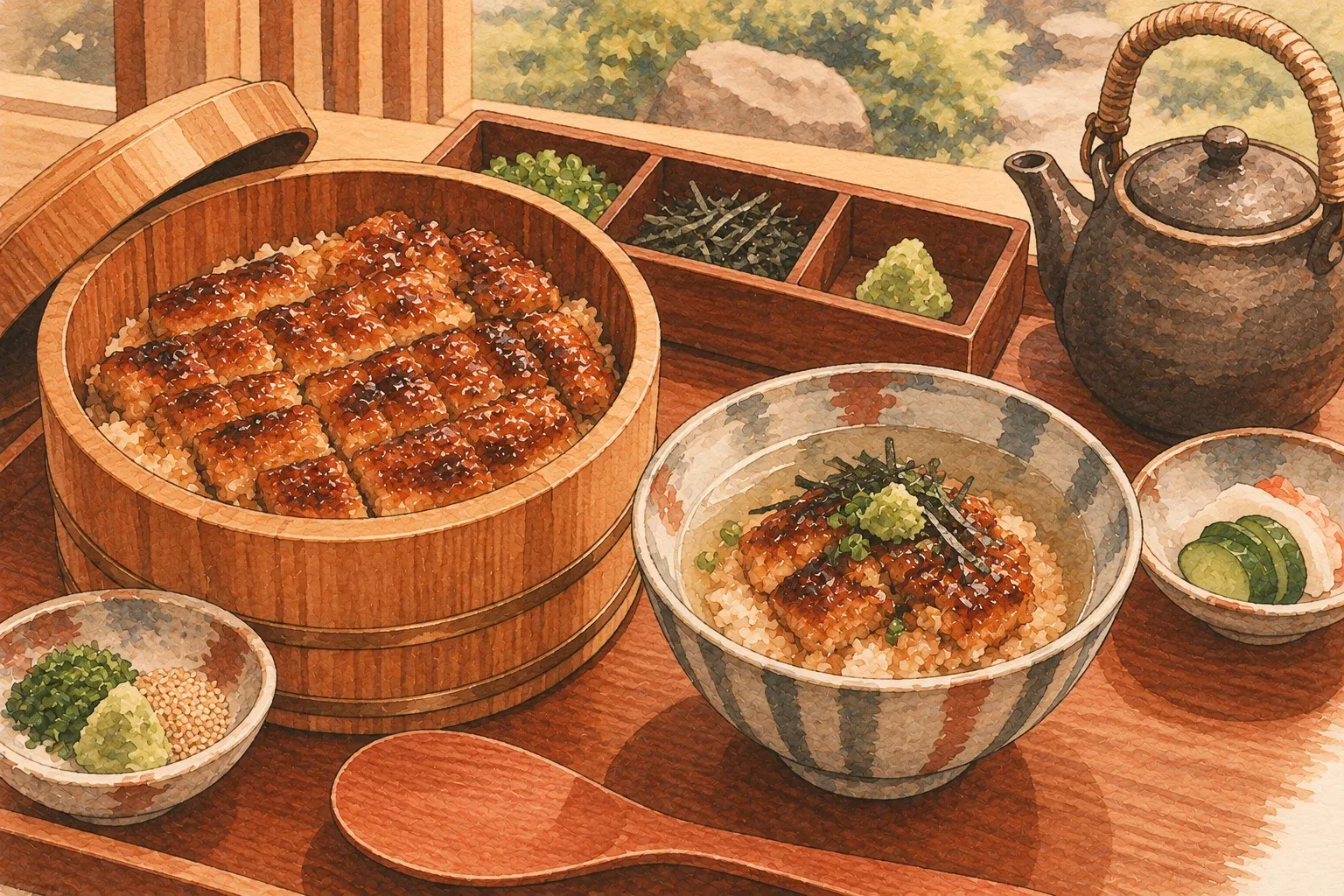
Atsuta Hōraiken was founded in 1873 at Miya-juku, and says it has topped up its tare since then and that today’s way of eating hitsumabushi was settled in the Meiji era. Its story of the name: it had an unbreakable wooden tub (hitsu) made and served eel and rice in it; customers ate the eel first, so the shop chopped the eel and mixed (mabushi) it into the rice.
The four steps, as the shop gives them:
- The first bowl as it is.
- The second with the condiments.
- The third as ochazuke, with broth poured over.
- The last however you liked best.
The shop says it grills over binchōtan charcoal; whether it steams, its pages do not say.
The shops, and what they charge
Unaju (eel) うな重
- Chains
- ¥1,060Unaju, basic grade · Unatoto · tax incl. · checked 2026-10-05
- Our guide figure
- from ¥2,500 (≈ €14 / $16)Eel is the one everyday dish that is genuinely expensive in Japan · Oct 2026
The figures above are kept on the price reference page and update there. Tax-included examples:
- Atsuta Hōraiken head shop: hitsumabushi ¥4,950; eel bowl ¥3,300 (three pieces), jō ¥4,100 (four), tokujō ¥5,700 (six); kabayaki ¥3,700 (four pieces).
- Unagi Edogawa, Nara (Kantō method): one eel on rice ¥4,400, ohitsumabushi ¥4,400.
The Osaka jiyaki shop’s prices are not given here.
Not all of Japan’s eel is this
- Kantō opens along the back, grills plain, steams and grills again, for soft eel. See the Kantō page.
- Yanagawa steams eel on rice in a basket (seiro-mushi).
Eating it in Kansai and Nagoya, and getting there
Osaka for jiyaki; Nagoya’s Atsuta for hitsumabushi; Hamamatsu, between the two, for both, as the city says. Check fares and journey times with the operator before you travel.
Kansai eel away from home
- The region spends. In the 2015–17 household survey, the top spenders on shop-bought kabayaki after Hamamatsu were Kyoto (¥4,224), Ōtsu (¥4,182), Nara (¥3,713) and Osaka (¥3,608), all above central Tokyo (¥3,352) and Nagoya (¥3,344).
- The eel is national. An Osaka jiyaki shop buys from at least seven prefectures. The style is local; the eel is not.
- The method crosses. Kansai has steaming shops and Tokyo has specialists using both methods, so read the shop, not the city.
What people get wrong
- “Kansai eel is just unsteamed Kantō eel.” It is opened differently, along the belly, and in Osaka grilled with the head on.
- “The belly cut is a merchant thing, the back cut a samurai thing.” One explanation among several; another traces Osaka’s belly cut to eel brought from Izumo in the 1750s.
- “Hitsumabushi is just an eel bowl.” It is eaten in stages, and the shop that tells its origin story says so.
- “Every Kansai shop grills without steaming.” Some do both; at least one steams.
Questions people ask
What is jiyaki?
Eel grilled straight over charcoal without steaming, the usual Kansai method. One Osaka shop founded in 1867 describes Osaka jiyaki as opening the eel from the belly and grilling it without steaming. I could not find an official definition of the word.
Why is eel called mamushi in Kansai?
The farm ministry says the word is said to come from mamushi, "steamed between", for grilled eel tucked between layers of rice to steam. Kyoto's tourism site notes that calling kabayaki mamushi is a Kansai usage.
How do you eat hitsumabushi?
Atsuta Hōraiken in Nagoya, which says the dish's name began at its shop, gives four steps. First bowl as it is, second with the condiments, third as ochazuke with broth, and the last however you liked best.
Sources
Prices are in Japanese yen. Conversions are approximate, at ¥177.30 to the euro and ¥158.23 to the US dollar as of 20 Oct 2026. Rates come from the European Central Bank, which publishes on working days only. Prices checked Oct 2026. What food costs in Japan →