
Tonkatsu: how a European cutlet became a Japanese set meal, and what the menu words mean
I have not been to every place in this guide. The figures below are taken from the sources listed at the end, with the date each one was published — not measured by me. Where I have been, the article says so.
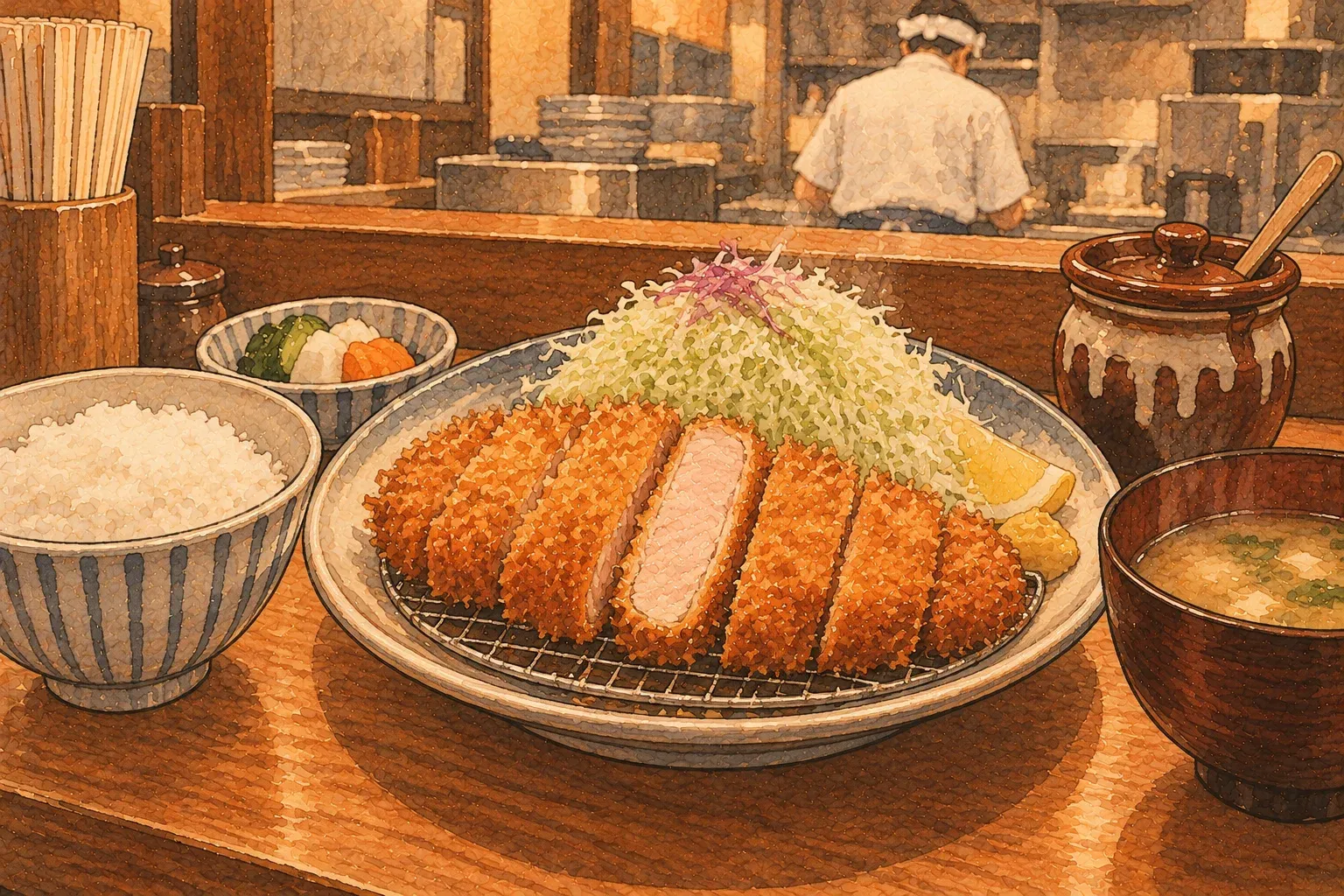
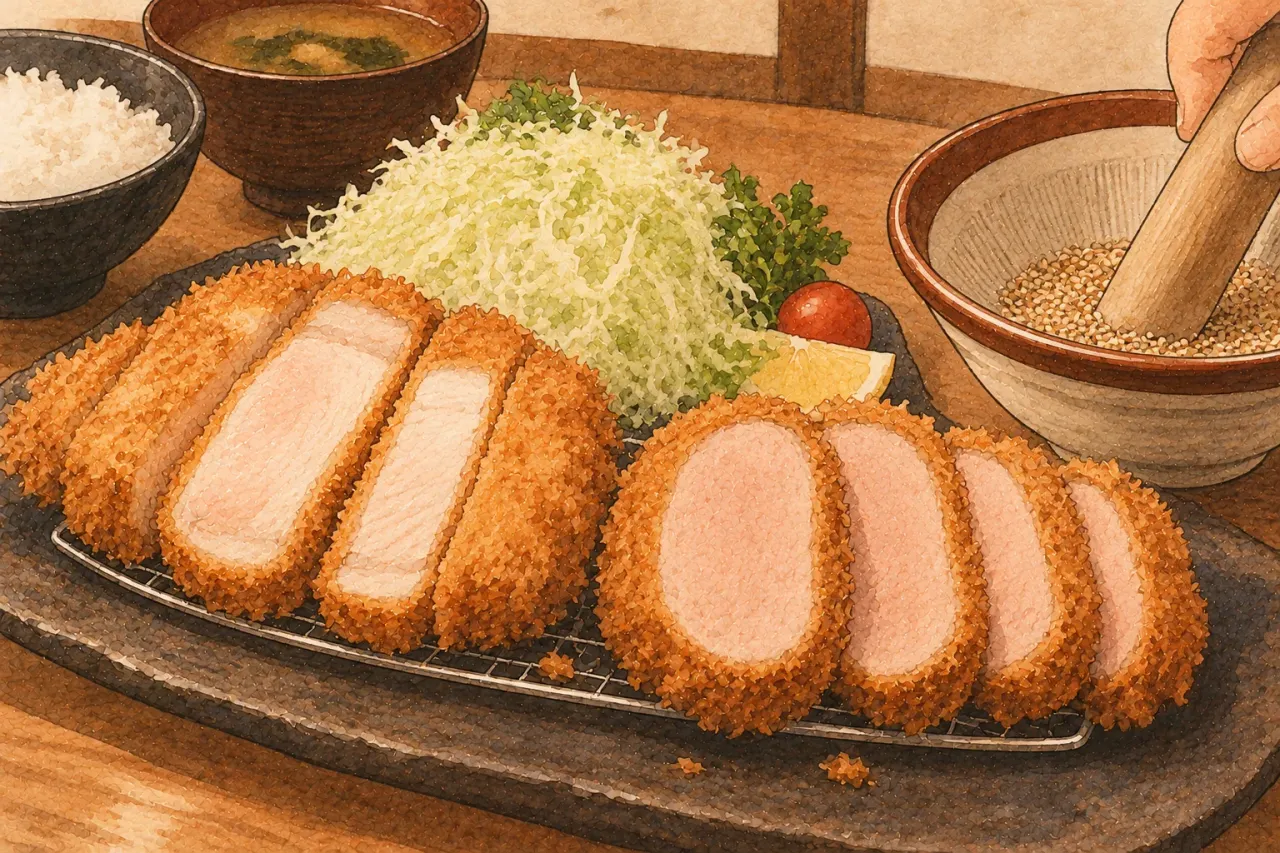
Tonkatsu is a breaded, deep-fried pork cutlet, cut into strips before it reaches you, served with a heap of raw shredded cabbage, rice, miso soup and a thick brown sauce. Every part of that arrangement has a reason, and most of the reasons were worked out in Tokyo’s Western-style restaurants between the 1890s and the 1920s. This page is the map: where the dish came from, why it is served the way it is, what the words on the menu mean, and what it costs. The lineage pages cover Nagoya’s miso-katsu and Osaka’s kushikatsu.
Where it came from
A cutlet that was not deep-fried. The Kikkoman food culture research centre points out that a European cutlet is cooked in a little fat in a pan. What took hold in Japan was deep-fried in plenty of oil, closer to tempura. It was first called pōku katsuretsu; the name tonkatsu spread in the early Shōwa era.
Deep-frying: Rengatei, Ginza. Kikkoman’s exhibition credits Kida Motojirō of Rengatei, a Western-style restaurant in Ginza, with deep-frying the cutlet in the early Meiji 30s (late 1890s): a small restaurant short of hands could fry two or three portions at once without the fuss of pan-frying. Its research journal gives 1899, and says he grated day-old bread into crumbs, coated the pork and fried it. The Chūō ward tourism association agrees on the restaurant (founded 1895) and the year, but calls him the first owner and says he devised a method using vegetable oil to suit Japanese tastes; Kikkoman calls him the second. This site does not choose.
The thick cut: Ueno. Kikkoman’s exhibition says the man who cut the pork as thick as frying would cook through and coated it in batter and crumbs was Shimada Shinjirō, a former cook in the Imperial Household Ministry, and that Ponta Honke in Ueno-Okachimachi is regarded as the originator of tonkatsu. Its research journal tells a different version: that when Shimada left the Imperial kitchens in 1929 he opened Ponchiken in Ueno and was the first to sell thick fried pork as “tonkatsu”. The journal does not mention Ponta. Same man, two shop names; the sources do not reconcile them.
Why pork. Kikkoman’s explanation: Japanese people who learned to eat meat through beef hotpot preferred beef, but during the Sino-Japanese and Russo-Japanese wars beef was canned for the army, more than 60,000 Russian prisoners had to be fed, and beef prices soared. Pigs, quick to raise, filled the gap. Because pigs cannot walk long distances to market, they were raised near cities, and pig farming grew in the early Shōwa era.
Chopsticks. A pork cutlet was eaten with a knife and fork. Tonkatsu came cut from the start, so it could be eaten with chopsticks: a casual Western dish.
Why it is served the way it is
The cabbage. Kikkoman’s research journal says that during the Russo-Japanese War Rengatei’s cooks went to the front, and the short-handed kitchen replaced cooked vegetables with raw cabbage, which needed no preparation. Cabbage was only then appearing in markets. The Chūō tourism association says both the cabbage and serving rice on the plate are said to have started there.
The rice. Customers wanted rice, not bread, so the restaurant served rice on a flat plate.
The sauce. Yamasa Shōyu launched “Mikado Sauce” in 1885 and stopped making it within about a year. A Japanese sauce built on soy sauce was completed in the Meiji 40s (around 1907–12), and butchers who gave away sauce with their croquettes and cutlets spread it.
So the tonkatsu set — cut pork, raw cabbage, rice — is Rengatei’s answer to a staffing problem, plus a sauce from butchers’ counters.
What the menu words mean
- Rōsu and hire. Loin and fillet. The farm ministry notes that pork cuts are defined in a national retail quality standard; I have not read that standard, so the definitions here are the shops’. Yabaton in Nagoya describes its loin as juicy and its fillet as fried slowly at a lower temperature, tender and light with little fat. It also offers rib, which it says is only about 2% of a pig.
- Kurobuta (black pork). There is no single national definition that I could find. Kagoshima’s standard, as the farm ministry describes it, is all Berkshire pigs, not raised with other breeds; the prefecture says its black pigs came from the Ryūkyūs about 400 years ago, were improved with English Berkshire in the Meiji era, and are fed a diet including sweet potato. Okayama calls only pure Berkshire kurobuta, and its “Okayama kurobuta” must be raised on approved farms in the prefecture and graded at the prefectural market. These are local standards.
What it costs
Tonkatsu set とんかつ定食
- Chains
- ¥690–¥1,530Pork loin cutlet set meal · Matsunoya, Katsuya, Tonkatsu Wako · tax incl. · checked 2026-10-05
- Our guide figure
- from ¥1,700 (≈ €10 / $11)Above the ¥2,000 line once you order the better cut · Oct 2026
The figures above are kept on the price reference page and update there. From one chain, Katsuya, tax included: loin cutlet set ¥913, double loin ¥1,177, fillet set ¥1,056; extra shredded cabbage ¥132 (¥129 to take away). It asks customers to check each shop’s page, since prices vary. Specialist shops — Yabaton, Rengatei — do not publish prices on their sites, so none are given here.
Refills. Whether the cabbage, rice and soup are refilled is up to the shop. One Osaka shop featured by the city’s tourism bureau offers free refills of rice, pork miso soup and lettuce or cabbage; at Katsuya, extra cabbage is a paid side.
How to eat it
- Season at the table. Shops differ. Osaka’s tourism bureau describes shops that put several sauces, salt, wasabi and black pepper on the plate, and others with mustard and a choice of two sauces on the table.
- The cabbage is a palate-cleanser, in one Osaka shop’s description.
- Chopsticks. It is cut so you can use them.
The lineages
The table is kept in one place so that every style is described on the same terms.
| Lineage | Origin | What it is | Sauce | How it is served | The thing to know |
|---|---|---|---|---|---|
| Nagoya miso-katsu 名古屋の味噌かつ | Nagoyaearly postwar (a stall story); Yabaton 1947 | Pork cutlet or kushikatsu with a sauce built on bean miso | Bean-miso base blended differently by each shop; thick or thin and sweet | Poured over, dipped in a pot of sauce, or on the side | Not on the farm ministry's list of Aichi local dishes; the miso behind it is |
| Osaka kushikatsu 大阪の串カツ | Shinsekai, Osakaone shop dates itself to 1929 | Meat, seafood and vegetables on skewers, battered, crumbed and deep-fried | A shared tray of thin sauce on the counter | By the skewer, with free raw cabbage | No double-dipping in the shared sauce; scoop with cabbage instead |
Lineages without a link are on the list but not written yet. The table is kept in one place so every lineage is described on the same terms.
Katsudon, the cutlet simmered with egg on rice, is covered on the rice-bowl pages.
Where to eat it
- Tokyo — Ginza’s Rengatei and the Ueno shops where the thick cut is said to have begun.
- Nagoya — miso-katsu, poured, dipped or on the side.
- Osaka — kushikatsu by the skewer in Shinsekai, and tonkatsu shops the tourism bureau sorts by branded pork, loin or fillet, katsudon and cutlet sandwiches.
Check fares and journey times with the operator before you travel.
The same cutlet, a different city
- Tokyo is where tonkatsu itself started, by every account above. Nagoya and Osaka are the homes of the variations.
- The variations have travelled. Yabaton, Nagoya’s miso-katsu chain, has shops in Tokyo, Osaka and elsewhere, and Aichi’s tourism site lists ten miso-katsu places in the Tokyo area. Daruma, the Osaka kushikatsu chain, lists 15 shops in Osaka and one in Kyoto.
- The shop decides more than the city. Whether sauce is poured or on the side, whether cabbage is free, which cuts are offered — all differ between shops in the same city.
What people get wrong
- “Tonkatsu is a traditional Japanese dish.” It is a Meiji Western dish made Japanese, and the name spread only in the early Shōwa era.
- “One restaurant invented it.” Deep-frying is credited to Ginza, the thick cut to Ueno, and the sources disagree on names within each story.
- “The cabbage is a garnish.” It began as a substitute for cooked vegetables in a short-handed kitchen.
- “Kurobuta means one thing.” Each prefecture or brand sets its own rules.
- “Cabbage refills are free everywhere.” At some shops; not at others.
Questions people ask
Who invented tonkatsu?
There is no single answer. Ginza's Rengatei is credited with deep-frying the cutlet around 1899, though sources disagree on whether it was the founder or his son. The thick cut is credited by one Kikkoman source to Shimada Shinjirō of Ponta Honke in Ueno, and by another to Ponchiken, the shop he opened after leaving the Imperial kitchens in 1929, said to be the first to sell it as "tonkatsu".
Why does tonkatsu come with shredded cabbage?
According to a Kikkoman research journal, Rengatei began serving raw cabbage during the Russo-Japanese War, when its cooks had gone to war and there was no time to prepare cooked vegetables. Cabbage was then a new vegetable in Japanese markets.
What is the difference between rōsu and hire?
Rōsu is loin, with its fat; hire is fillet. Nagoya's Yabaton describes its fillet as fried slowly in lower-temperature oil, tender, light, and with little fat. Which is better is a matter of taste.
Is kurobuta a guaranteed breed?
Only under each scheme's own rules. Kagoshima's kurobuta standard requires pure Berkshire pigs raised apart from other breeds, and Okayama's requires pure Berkshire graded by the national meat grading association. I could not find a single national rule.
Sources
Prices are in Japanese yen. Conversions are approximate, at ¥177.30 to the euro and ¥158.23 to the US dollar as of 20 Oct 2026. Rates come from the European Central Bank, which publishes on working days only. Prices checked Oct 2026. What food costs in Japan →