
Kushikatsu: Osaka’s fried skewers, the shared sauce, and why you dip only once
I have not been to every place in this guide. The figures below are taken from the sources listed at the end, with the date each one was published — not measured by me. Where I have been, the article says so.
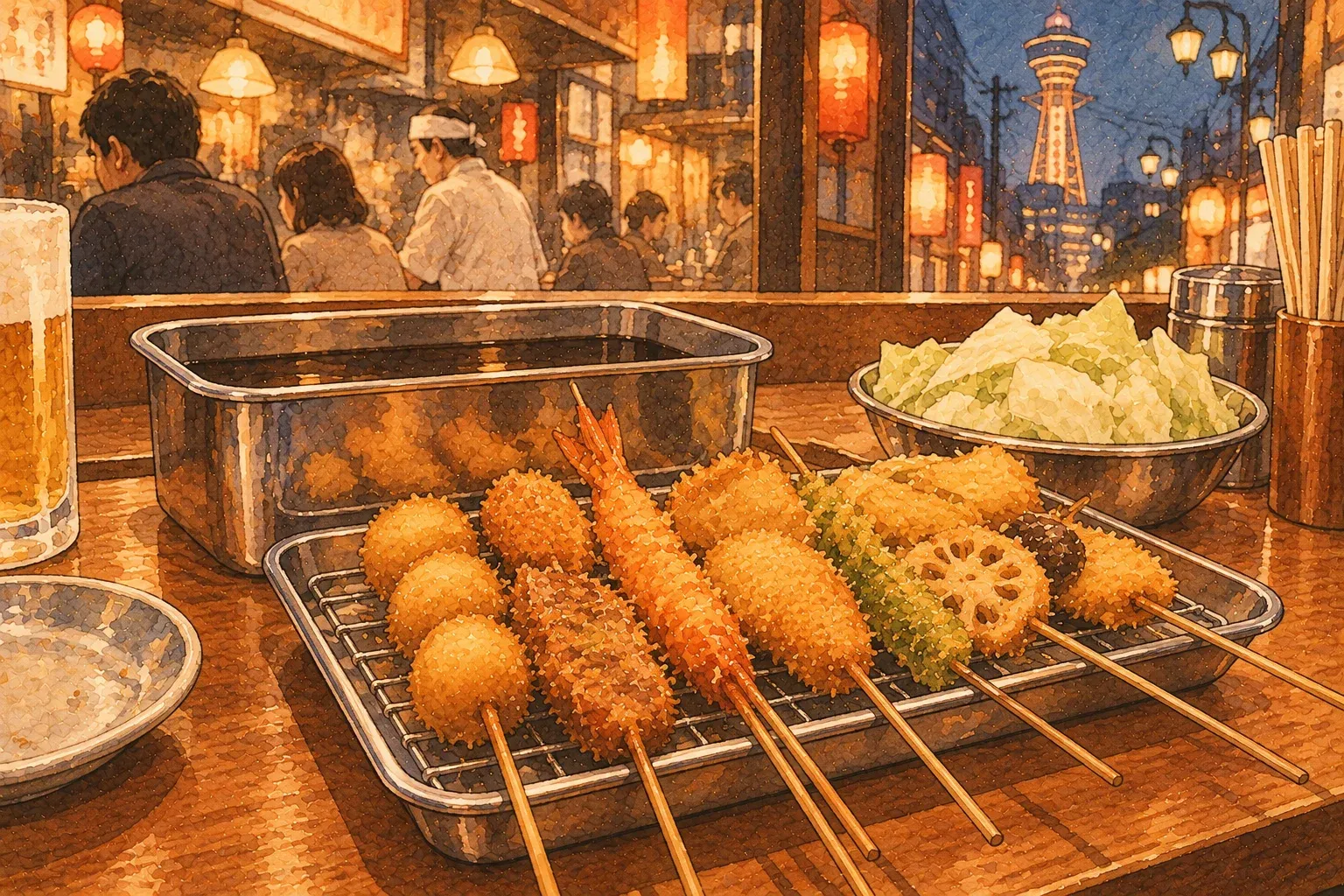
Kushikatsu is fried food on a stick: beef, prawn, asparagus, egg, cheese, almost anything, battered, rolled in breadcrumbs and deep-fried, then dipped in a tray of sauce on the counter. Osaka’s tourism bureau says the star is the texture of the coating. It is Osaka’s bar food, and it comes with the one table rule every visitor hears about — no double-dipping — which turns out to have a plain, practical reason.
For tonkatsu in general, start from the tonkatsu overview.
Where it came from
The best-documented history is one shop’s own. Kushikatsu Daruma says it was founded in 1929 by Momono Yoshie, under the name Takobishi, on the site of the old Luna Park amusement ground in Shinsekai, Osaka. Her idea was to let people eat expensive beef cheaply: bite-sized beef, skewered, coated and fried. A skewer cost one sen, and there were two items, beef and potato. In 1945 her successor Momono Masao rebuilt the shop and renamed it Daruma; the third generation wrote the name in hiragana, and the fourth took over in 2001.
That is Daruma’s history, not the history of kushikatsu. I have found no independent source on where kushikatsu as a whole began, so this site does not call Daruma the originator. Osaka’s tourism bureau says the Janjan Yokochō alley in Shinsekai is lined with old shops founded just after the war, and that Osaka has many specialist shops outside Shinsekai too.
The rule, and the reason
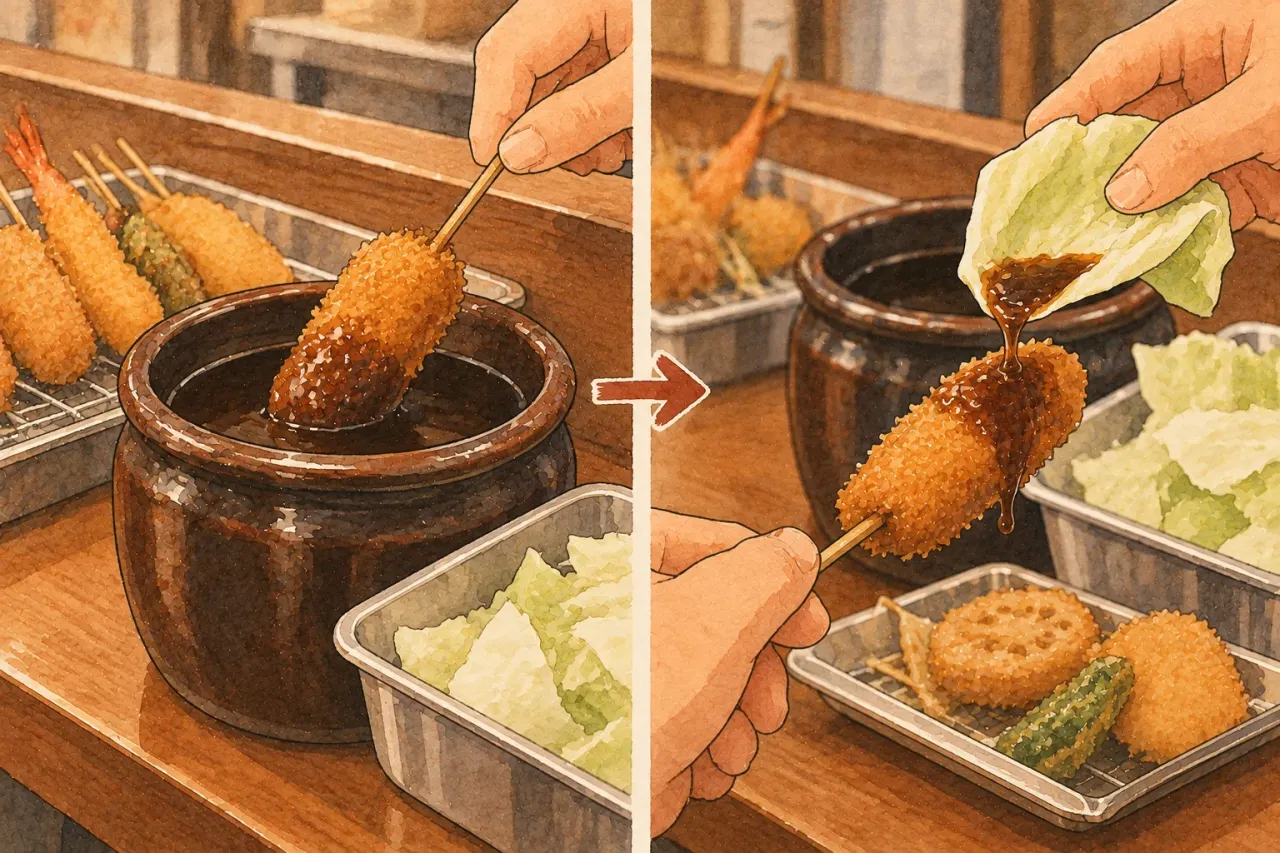
What the rule is. At counter-style shops, Osaka’s tourism bureau says, the sauce sits in a metal tray and you are asked not to dip twice.
Why. Daruma explains it plainly: the sauce is shared. A skewer you have bitten does not go back in. If you want sauce on the second bite, scoop some up with a leaf of cabbage and pour it over the skewer. Its page on its cooking says the point is that other customers can use the sauce happily too.
The cabbage. At counter shops the cabbage next to the sauce is free and unlimited, the tourism bureau says. Daruma says it started giving it away in the second generation, from 1945, with the double-dipping rule — the cabbage is the scoop.
Not universal. The tourism bureau distinguishes pub-style shops that ban double-dipping from more inventive shops. Look at the sauce: a shared tray means one dip.
What makes it kushikatsu
- The coating — a flour-and-water batter, then breadcrumbs. Daruma describes its own as crisp first, then chewy.
- The oil — Daruma uses its own blend with beef tallow (hetto), and says its second owner checked every delivery of oil himself.
- The range — beef was the original; today the tourism bureau lists prawn, asparagus, egg and cheese among many.
The shops, and what they charge
Kushikatsu, per skewer 串カツ(1本)
- Chains
- ¥143–¥209One beef skewer · Kushikatsu Dengana, Kushikatsu Tanaka · tax incl. · checked 2026-10-05
- Our guide figure
- from ¥250 (≈ €1 / $2)Priced per skewer. A meal is several, and the sauce is not for dipping twice · Oct 2026
The figures above are kept on the price reference page and update there. I did not check Daruma’s menu prices for this page.
How to order it
- Order by the skewer.
- Dip once, in the shared tray.
- Use the cabbage — to eat between skewers, and to scoop sauce.
Not all fried cutlet is this
- Tonkatsu is a whole cutlet, cut into strips, with rice and a thick sauce — a Tokyo invention.
- Nagoya’s miso-katsu puts a bean-miso sauce on cutlets and skewers; Aichi’s own origin story has a kushikatsu dropped into a pot of miso offal. Whether that kushikatsu and Osaka’s share an ancestry, the sources do not say.
Eating it in Osaka, and getting there
Shinsekai, around Janjan Yokochō, is where the tourism bureau sends visitors. Check fares and journey times with the operator before you travel.
Kushikatsu away from Osaka
- The big name stays home. Daruma lists 15 shops in Osaka and one in Kyoto, plus Jakarta (from May 2024) and a temporary Expo shop. Its company profile lists none in the Tokyo area.
- The rule varies by shop, in Osaka and anywhere else.
What people get wrong
- “No double-dipping is just etiquette theatre.” It keeps a shared sauce clean, and the cabbage is there so you can get more.
- “Daruma invented kushikatsu.” Daruma dates its own shop to 1929. Nobody has documented the dish’s first shop.
- “Kushikatsu is always beef.” Beef was the start; now it is almost anything.
- “Every shop has the same rules.” The tourism bureau says pub-style shops and inventive shops differ. Watch how the sauce is served.
Questions people ask
Why can't I dip twice?
Because the sauce in the tray is shared with the customers next to you. Kushikatsu Daruma explains that a skewer you have bitten must not go back in. If you want more sauce, scoop it up with a piece of the free cabbage and pour it on.
Is the cabbage free?
At counter-style kushikatsu bars, Osaka's tourism bureau says the cabbage beside the sauce is all-you-can-eat. Daruma says it began giving it away when it introduced the no-double-dipping rule.
Does every kushikatsu shop ban double-dipping?
No. Osaka's tourism bureau distinguishes pub-style shops that ban double-dipping from more creative shops. Ask, or look at how the sauce is served.
Sources
Prices are in Japanese yen. Conversions are approximate, at ¥177.30 to the euro and ¥158.23 to the US dollar as of 20 Oct 2026. Rates come from the European Central Bank, which publishes on working days only. Prices checked Oct 2026. What food costs in Japan →