
Miso-katsu: Nagoya’s pork cutlet in bean-miso sauce, and the three ways it reaches the table
I have not been to every place in this guide. The figures below are taken from the sources listed at the end, with the date each one was published — not measured by me. Where I have been, the article says so.
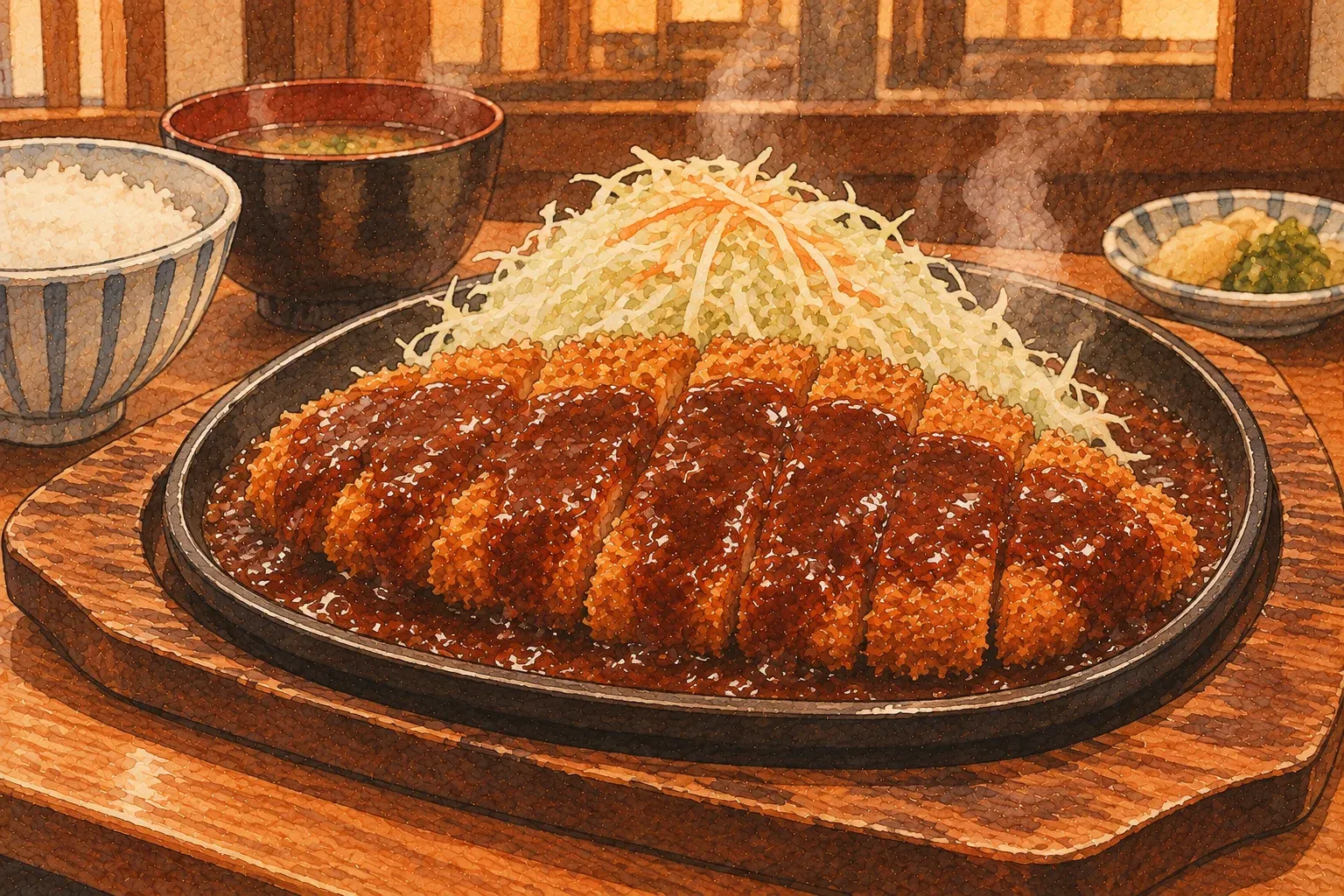
Miso-katsu is Nagoya’s version of tonkatsu: the same breaded pork cutlet, under a dark, sweet sauce built on bean miso instead of the usual brown sauce. It is one of the dishes Nagoya sells as Nagoya-meshi, the city’s own food, and it has spread well beyond the city. What is less known is that there is no single way to serve it, and no single story of where it began.
For tonkatsu in general, start from the tonkatsu overview.
Where it came from
A stall story. Aichi prefecture’s tourism site says that in the early postwar years a customer at a food stall dropped a kushikatsu skewer into the dote-nabe, the pot of miso stew, and found it delicious; others copied him, it became a craze, and then a local speciality. The page names no stall and cites no record, so treat it as the story the city tells.
Yabaton, 1947. The best-known shop, Yabaton, was founded in 1947 and calls its sauce “the secret miso sauce we have kept since 1947”. Nagoya’s tourism site describes it as using pork from southern Kyushu, its own breadcrumbs, and a sauce made from naturally brewed bean miso aged for a year and a half. A related shop, Mukashi no Yabaton (Yabaton of the old days) at Ōsu Kannon, introduces its kushikatsu as “the original miso-katsu” and says it uses a different coating from the chain’s tonkatsu. That is the shop’s own description.
Why miso
The farm ministry’s database of local dishes explains the miso behind it, in its entry on Aichi’s miso oden: bean miso (mame-miso, red miso), with Hatchō miso as its best-known kind, is indispensable to Aichi’s food. It is made from soybeans fermented with kōji for a long time — at least a year, sometimes two or three — and has depth, acidity and astringency. The village of Hatchō, now part of Okazaki, stood where the Tōkaidō road met the Yahagi river, which is said to have made soybeans and salt easy to obtain.
Note what the ministry does not say. Its list of Aichi local dishes includes miso oden, miso-nikomi udon and miso dengaku, but not miso-katsu. So the sauce draws on an old local ingredient, while the dish is a postwar city speciality, not a registered local dish.
What makes it miso-katsu
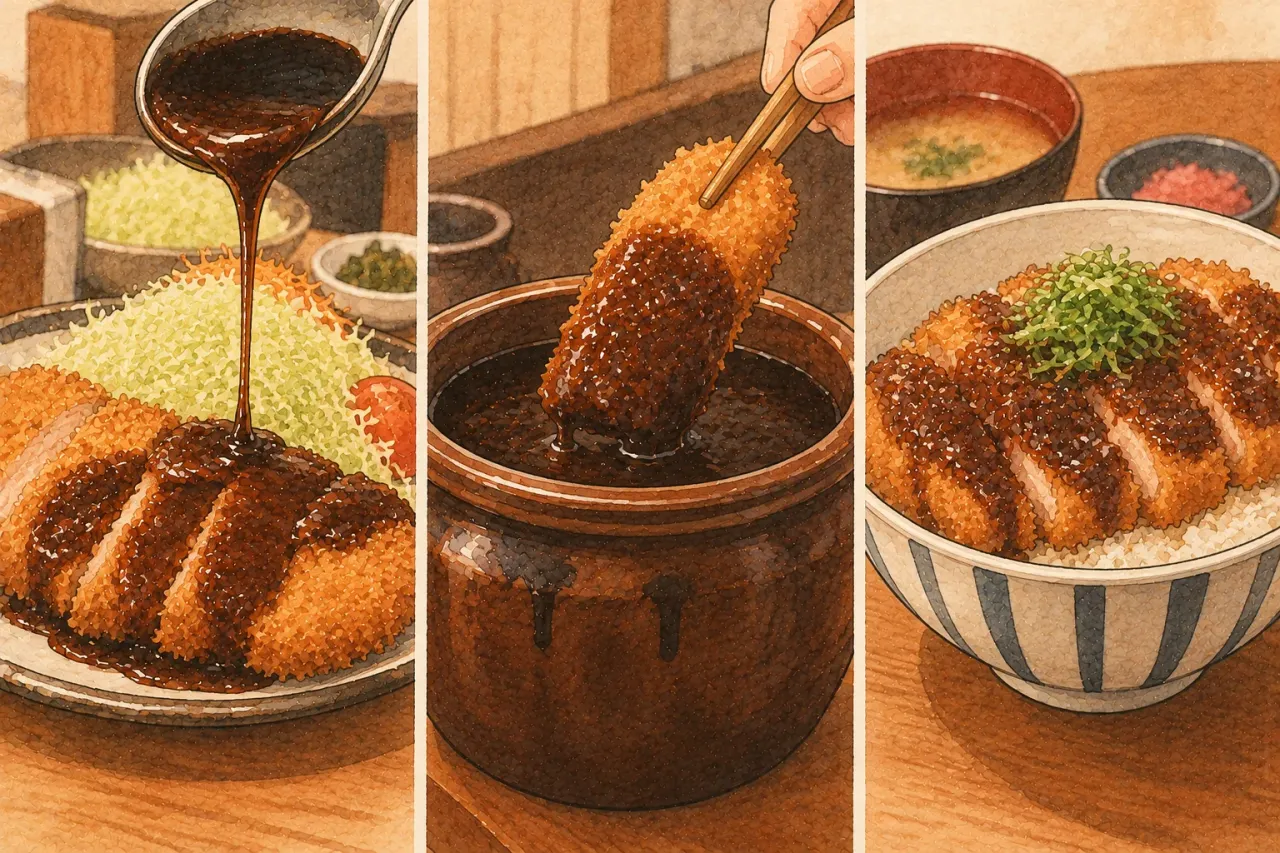
Nagoya’s tourism site gives the definition: a pork cutlet with a sauce based on bean miso, including kushikatsu. The miso is not used as it is; each shop blends it with other seasonings. And there are three ways to serve it:
- Poured over the cutlet.
- Dipped — the cutlet is put into a pot of sauce.
- On the side, in a separate dish, at some Western-style restaurants.
Aichi’s tourism site adds that sauces fall into two broad types: thick and rich, or thin and sweet.
The shops, and what they charge
Tonkatsu set とんかつ定食
- Chains
- ¥690–¥1,530Pork loin cutlet set meal · Matsunoya, Katsuya, Tonkatsu Wako · tax incl. · checked 2026-10-05
- Our guide figure
- from ¥1,700 (≈ €10 / $11)Above the ¥2,000 line once you order the better cut · Oct 2026
The figures above are national tonkatsu prices from the price reference page. Yabaton does not publish prices — its menu says they vary by shop — and neither does Nagoya’s tourism site, so no Nagoya prices are given here.
What Yabaton offers, from its menu: loin, fillet, waraji (a large flat loin cutlet, which can be half miso and half regular sauce), rib, teppan (served on a hot iron plate), miso-katsu on rice, black-pork cutlets labelled as Kagoshima kurobuta, and an assortment. Not every shop has every item.
Waiting. Yabaton’s site shows live waiting times by shop and takes bookings.
How to eat it
Aichi’s tourism site suggests:
- First, as it comes.
- With mustard, for a lighter taste.
- With ground sesame, for fragrance.
- With chilli, for heat.
Not all tonkatsu is this
- Ordinary tonkatsu comes with a thick brown sauce.
- Osaka fries kushikatsu by the skewer and dips them in a shared tray of sauce, once only. See the kushikatsu page.
Whether Nagoya’s miso kushikatsu and Osaka’s kushikatsu share an ancestry, the sources used here do not say.
Eating it in Nagoya, and getting there
Yabaton’s Yabachō main shop and Mukashi no Yabaton at Ōsu Kannon are both featured by the city’s tourism site. Check fares and journey times with the operator before you travel.
Miso-katsu away from Nagoya
- You can eat it elsewhere. Yabaton lists shops in Mie, Toyama, Osaka (Hankyū Sanbangai, Abeno Harukas, Daimaru Shinsaibashi) and Tokyo (Ginza, Tokyo station’s Gransta Yaesu, Haneda Airport Garden, and a takeaway-only counter in Tokyo station). Aichi’s tourism site lists ten miso-katsu places in Tokyo and Saitama.
- The menu changes. Yabaton notes that some items, such as the waraji, half-and-half or iron-plate cutlets, are not available at every shop.
- The serving changes. In Nagoya itself you will meet all three styles — poured, dipped, on the side. A single chain branch elsewhere shows you one.
What people get wrong
- “Miso-katsu is a traditional Aichi dish.” The miso is traditional. The dish is postwar, and the farm ministry does not list it.
- “It is cutlet with miso spread on it.” The sauce is a blend that each shop makes differently.
- “It always comes covered in sauce.” It may be dipped, or served on the side.
- “Yabaton invented it.” Yabaton dates its sauce to 1947. The city’s origin story is an unnamed stall.
Questions people ask
What is miso-katsu?
Nagoya's tourism site defines it as a pork cutlet with a sauce based on bean miso, and includes kushikatsu skewers. Each shop blends the miso with other seasonings in its own way.
Is miso-katsu a traditional local dish?
It is a postwar Nagoya speciality. The farm ministry's database of Aichi local dishes does not list it, though it does list other dishes built on the same bean miso, such as miso oden and miso-nikomi udon.
How should I eat it?
Aichi's tourism site suggests trying it as it comes first, then with mustard for a lighter taste, ground sesame for fragrance, or chilli for heat.
Sources
Prices are in Japanese yen. Conversions are approximate, at ¥177.30 to the euro and ¥158.23 to the US dollar as of 20 Oct 2026. Rates come from the European Central Bank, which publishes on working days only. Prices checked Oct 2026. What food costs in Japan →