
Slurping noodles in Japan: what the official sources say, the explanations given, and the 2016 noodle harassment row
I have not been to every place in this guide. The figures below are taken from the sources listed at the end, with the date each one was published — not measured by me. Where I have been, the article says so.
In many Japanese noodle shops, people draw their noodles in with an audible slurp. What the official sources say about it is gentler than a rule — you may slurp, and you need not — and the reasons given for the habit differ from source to source. This column sets them side by side.
The soba overview and the Edo-style soba page already cover the noodle federation’s advice on dipping and the buckwheat broth served afterwards, so this column touches on it only briefly.
What the official sources say
Japan’s national tourism organisation (JNTO) addresses it on three pages:
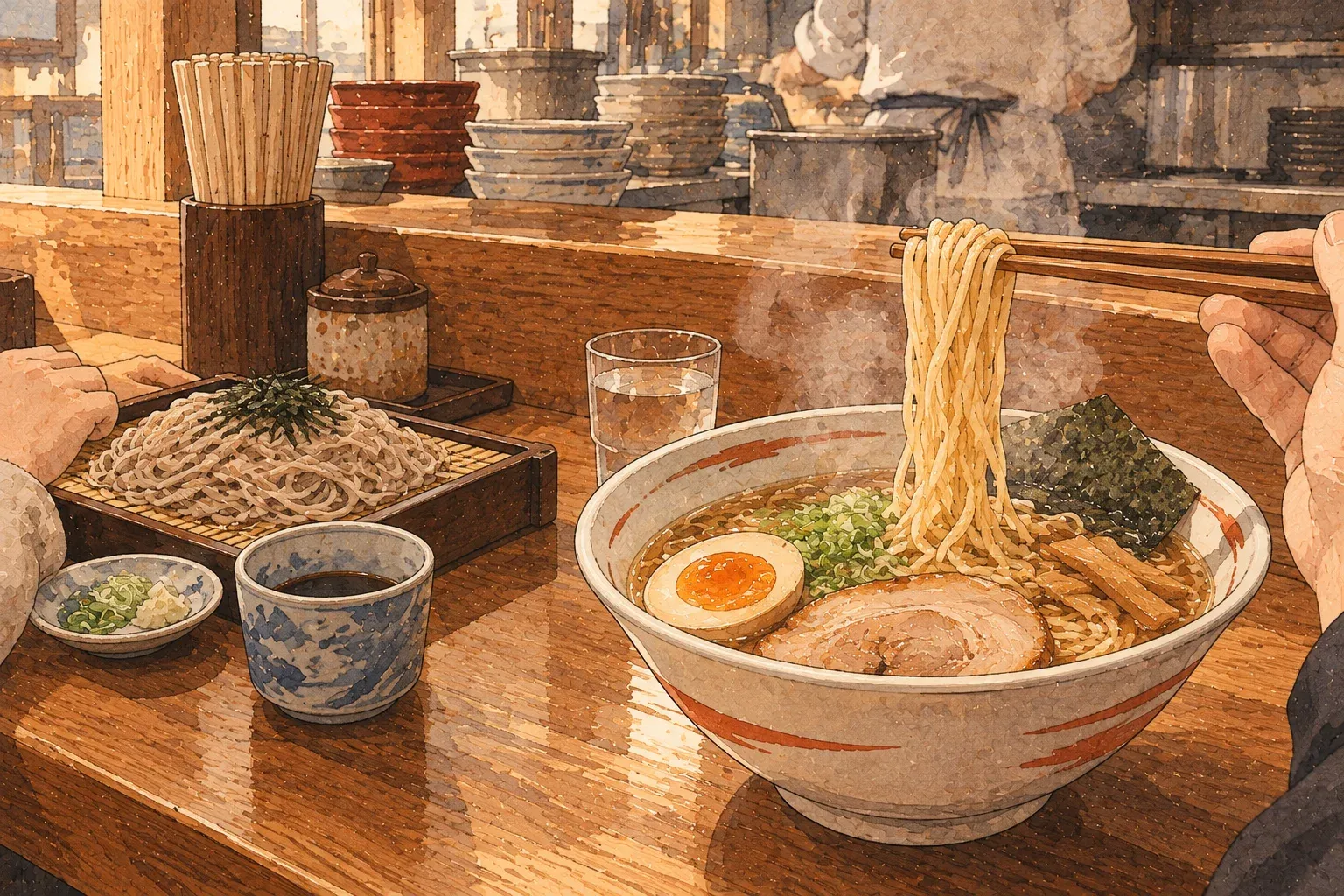
- Its ramen guide: “While eating your noodles, try to slurp like the locals.” It is “not considered rude at all”, and many people find it makes eating noodles with chopsticks easier. It adds a practical note: focus on drawing the noodles into your mouth, not on making noise for its own sake.
- Its food etiquette page: “Do feel free to slurp your noodles.”
- Its manners page: at most shops, people slurp as they eat. The same page says not to judge how locals eat, and tells visitors: “don’t feel obligated to slurp yourself.”
An older JNTO blog post, from June 2013, frames it as an exception. Making noise while eating is rude, it says, except when eating Japanese noodles — soba, udon, ramen, sōmen — and drinking miso soup.
The noodle trade’s own federation, in a dialogue on its website about how to eat soba, has a shop owner say you eat by drawing the noodles in with a zuzuzu sound, and a character calls eating them in one go like that iki — stylish. The page gives no reason. It also says soba is enjoyed through aroma, flavour and the feel of it going down.
Why: the explanations given
The sources do not agree on one reason, and this site does not choose between them.
- Aroma. Horii Yoshinori of Sarashina Horii, a long-established soba shop, told nippon.com that soba’s aroma is enjoyed in the mouth rather than the nose. Cold mori soba does not give off much aroma, he said, so you slurp hard to spread it through the mouth. He added that when soba used to be steamed and eaten, people may have noticed the aroma in the steam, found it tasted better slurped, and the habit took hold naturally. That last part is his view of how it is likely to have happened.
- Ease. JNTO says many people find slurping makes noodles easier to eat with chopsticks.
- Hurried eating in Edo. The nippon.com writer suggests that because Edo soba was fast food for ordinary people, sold from street stalls and by night vendors and eaten standing up in a hurry, the habit of noisily shovelling it in arose there. The article mentions some 700 soba shops in Edo in the 1800s. This is the writer’s inference; the primary sources behind it have not been checked for this page.
- Flavour, from a magazine. Time Out Tokyo wrote in 2023 that some noodle lovers think slurping brings out the flavour, comparing it to a sommelier aerating wine, and also pointed to busy office workers eating quickly. It does not name who says so. Some people explain it this way.
You may have read that slurping cools the noodles, or that it shows respect to the cook. No official source checked for this page supports either of these or the flavour explanation, and no scientific study showing that slurping strengthens aroma is confirmed, so this page does not repeat them as fact.

Not everyone in Japan sees it the same way
The sources describe different settings rather than one rule:
- JNTO says slurping is fine, and not required.
- The noodle federation calls it stylish.
- Mr Horii does not actively teach foreign customers to slurp. He would rather they first come to appreciate how good soba is.
- The nippon.com article also notes that in formal Japanese dining, not making noise is considered good manners.
So whether to slurp depends on where you are eating. No source checked for this page lays down a single rule for all occasions.
The noodle harassment row, 2016–17
According to nippon.com, in 2016 a Twitter account claimed that the sound of slurping was “noodle harassment” (nū-hara) that made foreigners uncomfortable. It was widely retweeted, picked up by television and newspapers, and argued over. The same article describes the fuss as without concrete basis and says it soon subsided. No source checked for this page gives a survey measuring how many foreign visitors actually objected, and nippon.com identifies the starting point only as a 2016 Twitter account.
A fork that masked the sound. On 23 October 2017 Nissin Foods opened pre-orders on its online store for Otohiko, a fork that covered the sound of slurping cup noodles with another sound. Nikkan Kogyo Shimbun reported that Nissin presented it as a way to resolve friction over differing attitudes to the sound. The price announced was ¥14,800 including tax, and it would only go on sale if at least 5,000 were pre-ordered. ITmedia reported in December 2017 that pre-orders fell short of 5,000 and it would not be produced. That report was read only in part for this page, so treat the detail with some caution.
If you would rather not slurp
That is fine, by JNTO’s account. No shops’ or local governments’ own notices about offering forks or spoons for noodles were found for this page; the column on chopsticks covers what a 2008 government manual advised businesses about forks.
What people get wrong
- “You must slurp, or it is rude.” JNTO says you need not.
- “Slurping is rude in Japan, as it is elsewhere.” JNTO says it is not considered rude with noodles.
- “There is one reason for slurping.” The sources give several, and they are views, not settled fact.
- “Slurping cools the noodles.” No official source checked for this page says so.
Questions people ask
Is it rude to slurp noodles in Japan?
JNTO says it is not considered rude at all, and that at most shops people slurp. A 2013 JNTO blog post says making noise while eating is otherwise rude, with noodles and miso soup as the exceptions.
Do I have to slurp?
No. JNTO’s manners page says visitors need not feel obliged to slurp. A soba shop owner interviewed by nippon.com said he does not teach foreign customers to slurp, and would rather they first enjoy the taste of the soba.
Why do Japanese people slurp noodles?
The sources give different explanations and this site does not choose. A soba shop owner says it spreads the aroma in the mouth, JNTO says many people find it makes eating with chopsticks easier, and a nippon.com writer suggests it began with hurried eating at Edo street stalls.
What was noodle harassment?
In 2016 a Twitter account claimed the sound of slurping upset foreign visitors and called it noodle harassment. It drew TV and newspaper coverage. nippon.com called it groundless and said it soon died down.
Sources
Prices are in Japanese yen. Conversions are approximate, at ¥177.30 to the euro and ¥158.23 to the US dollar as of 20 Oct 2026. Rates come from the European Central Bank, which publishes on working days only. Prices checked Oct 2026. What food costs in Japan →