
Roadside stations and farm stands in Japan: what a michi-no-eki is, how the system began, and what the official figures say
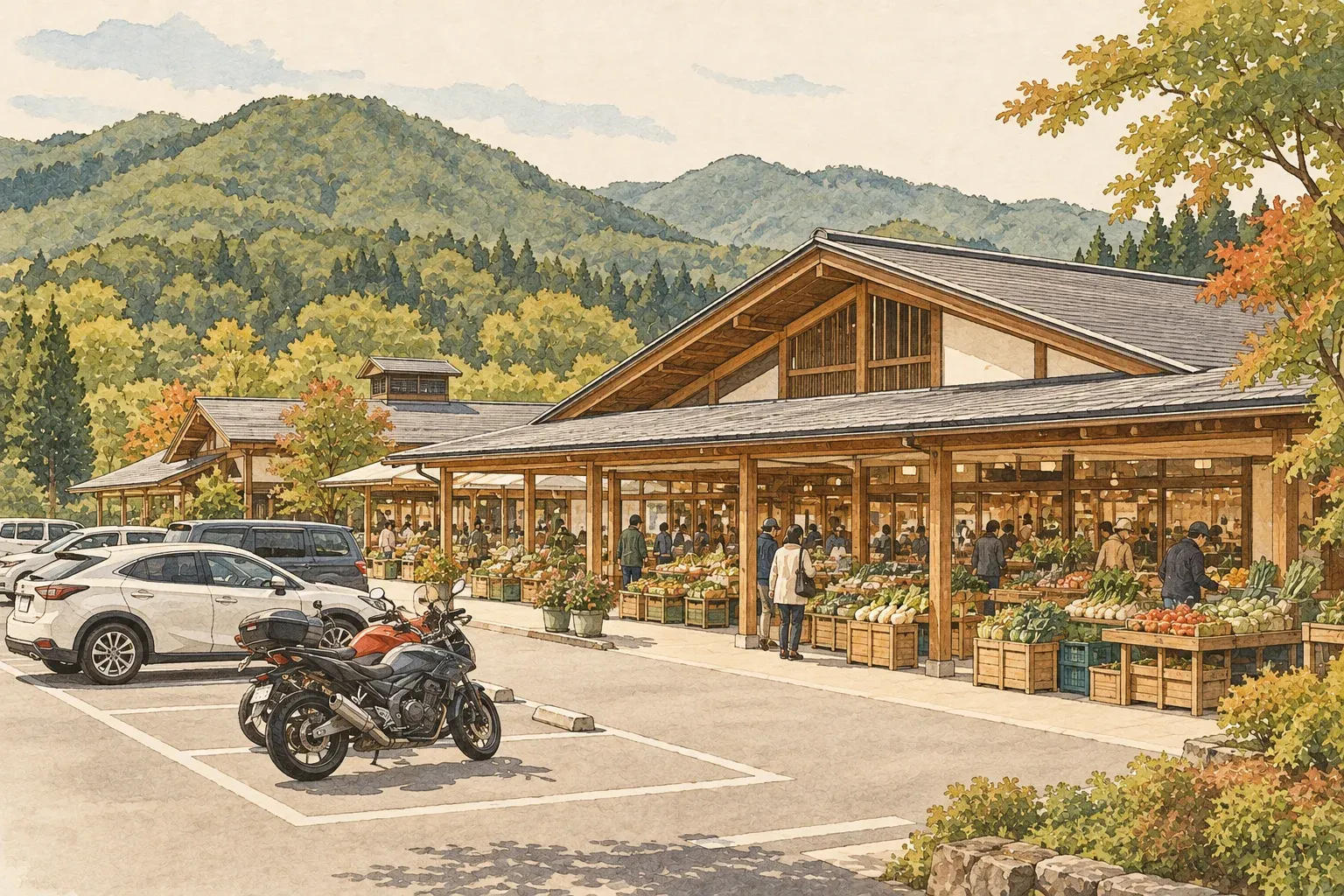
I have not been to every place in this guide. The figures below are taken from the sources listed at the end, with the date each one was published — not measured by me. Where I have been, the article says so.
Drive or ride a bus through rural Japan and you will pass buildings signed 道の駅, michi-no-eki, literally “road station”. They are part of a government registration system, not a chain. This column sets out what the official sources say about how that system began, what a visitor can expect to find, and what the farm ministry’s figures say about the farm stands that sell local produce. It does not cover prices; I could not confirm any tax-inclusive price for this page.
What a michi-no-eki is
The official site, run by the National Council of Michi-no-Eki (全国道の駅連絡会), describes a roadside station as a facility that provides a safe and comfortable traffic environment for road users and helps create liveliness in the local area. It also calls them, in rough translation, lively places with their own character, built together with the community. The council is organised in nine regional blocks across the country.
You will often read that every station has three basic functions — rest, information and regional cooperation — and that registration requires parking and toilets of a certain size. I could not read the ministry’s own guidelines document to confirm the exact wording or numbers, so this page does not give them.
How the system began
The land and transport ministry’s own history page dates it in steps:
- October 1991. A trial of “michi-no-eki” began in three prefectures — Yamaguchi, Gifu and Tochigi — and ran until April 1992.
- 18 January 1993. The chair of a ministry advisory panel presented a proposal.
- 23 February 1993. The guidelines for setting up the system were drawn up.
- 22 April 1993. The first round of registration: 103 stations nationwide.
So the system was set up in February 1993, and the first stations were registered that April. JNTO describes michi-no-eki as “a system of government-designated rest stops launched in the mid-1990s”. This page uses the ministry’s dates.
How many there are
The ministry’s figures grew from 470 stations (17 April 1998) to more than 900 (12 March 2009) and 1,005 (27 March 2013). As of 4 September 2026, after the 65th round of registration, its list shows 1,234.
Two things to know about that number:
- It can fall as well as rise. The ministry records that registrations have also been withdrawn.
- Not every page is updated at once. On the official council site, a news item dated 8 September 2026 says 1,234 stations nationwide, while a heading on the same page still read 1,231 when I checked on 10 October 2026. The ministry’s list is the latest figure.
JNTO says there are michi-no-eki in every prefecture, numbering more than 1,000 in total.
What JNTO says you will find
JNTO’s guide for visitors lists:
- free parking
- clean toilets open 24 hours a day, 365 days a year
- vending machines with hot and cold drinks
- free Wi-Fi
- at some stations, showers, charging, ATMs and spaces for babies
It also says they are a place to try local food and products, giving apples in Aomori and masu-zushi (trout sushi) in Toyama as examples. Its advice: each station is different, so stopping at more than one is worthwhile; the staff can tell you about the area; and in rural areas English signage may be limited.
The official council site lets you filter stations by whether they have a restaurant, light meals, a café or a shop. It also runs an online shop, “Michi-no-Eki Marché”, for souvenirs and food from stations around the country, and a feature on seasonal and unusual ingredients from across Japan.
What I could not confirm. Many visitors associate michi-no-eki with local side dishes and soft-serve ice cream. I found no official source explaining why those are sold there, or how common they are, so this page does not describe them.
Farm stands: the official figures
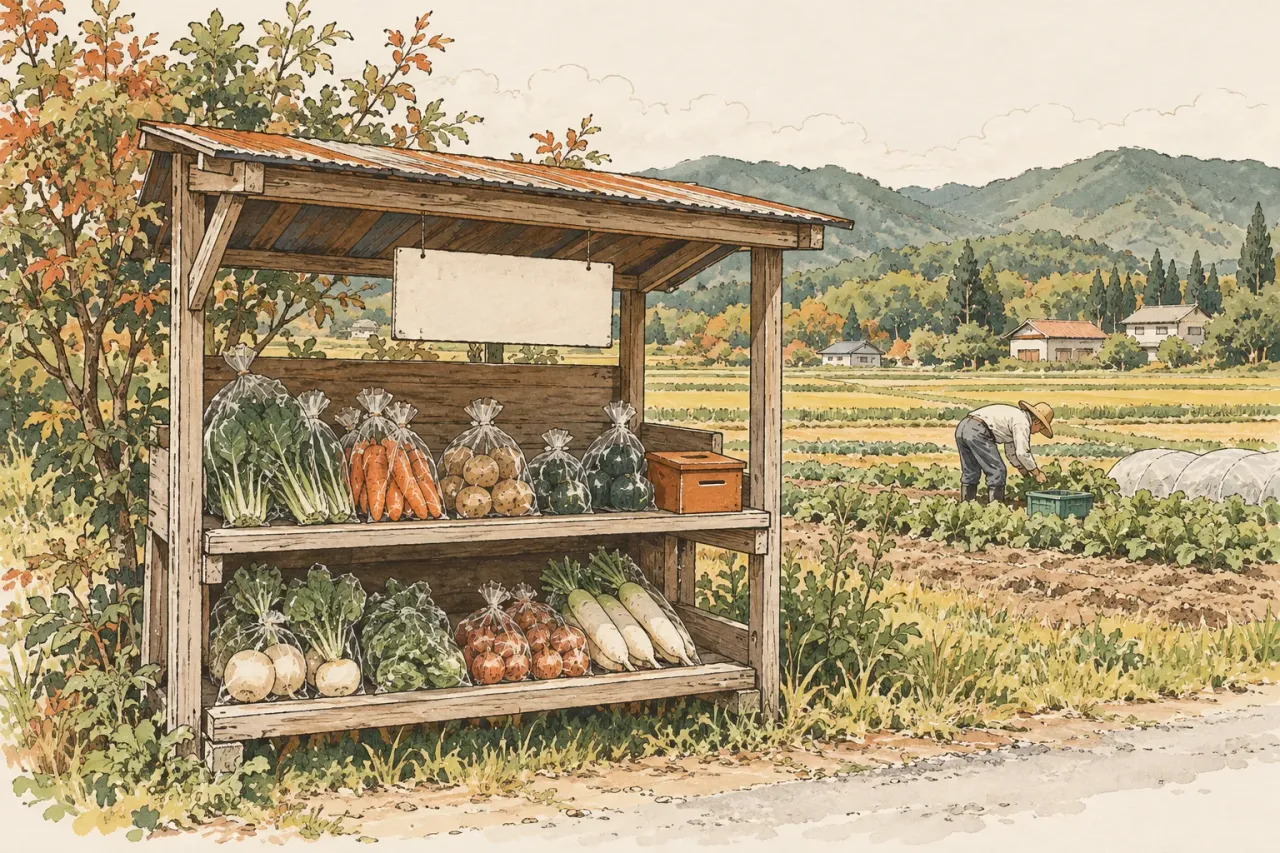
Many michi-no-eki sell local produce, and Japan also has farm produce stands (農産物直売所, nōsanbutsu chokubaijo) that stand alone. The farm ministry’s survey of farm businesses that process and sell their own produce gives annual sales at these stands:
| Fiscal year | Annual sales (million yen) |
|---|---|
| 2020 | 1,053,477 |
| 2021 | 1,046,385 |
| 2022 | 1,087,897 |
| 2023 | 1,126,420 |
| 2024 | 1,134,381 |
That is about 1.13 trillion yen in fiscal 2024. The same page puts the number of people working at them in fiscal 2024 at 1,719 hundred people, or roughly 170,000. It does not say how many stands there are.
An older count. A farm ministry collection of case studies, last updated 31 May 2016, gives about 23,700 stands nationwide and total sales of about 900 billion yen in fiscal 2013. It also says some stands are struggling to keep going, partly because the farmers who supply them are getting older. That survey and the newer one may differ in method and scope, so I do not compare the two to say sales have grown.
What I could not confirm. Who sets the prices at a farm stand, what commission the operator takes, and how suppliers and operators split the work — I found nothing on these in the farm ministry’s materials, so this page does not describe them.
Getting there
Check fares and journey times with the operator before you travel.
What people get wrong
- “Michi-no-eki are a chain.” They are registered under a ministry system and run locally; the official site describes each as built together with its community.
- “The system started in the mid-1990s.” The ministry dates the trial to 1991 and the first registration to April 1993. JNTO’s “mid-1990s” is a looser description.
- “The number only goes up.” The ministry records withdrawals of registration as well as new ones.
- “Farm-stand sales rose from 900 billion to 1.13 trillion yen.” Those come from different surveys, years apart, and may not be comparable.
Questions people ask
What is a michi-no-eki?
A roadside station registered under a system run by the land and transport ministry. The official site describes them as facilities that provide a safe and comfortable environment for road users and help bring life to the local area.
How many michi-no-eki are there?
The land and transport ministry lists 1,234 as of 4 September 2026, after its 65th round of registration. Registrations are also withdrawn, so the number can go down as well as up.
Can I find English at a michi-no-eki?
JNTO says English signage can be limited in rural areas, and suggests asking the staff for local information.
How big are farm stands in Japan?
The farm ministry puts annual sales at farm produce stands at about 1.13 trillion yen in fiscal 2024. I could not find a current official count of how many stands there are.
Sources
Prices are in Japanese yen. Conversions are approximate, at ¥177.30 to the euro and ¥158.23 to the US dollar as of 20 Oct 2026. Rates come from the European Central Bank, which publishes on working days only. Prices checked Oct 2026. What food costs in Japan →