
Queues, waiting lists and how long to stay at a Japanese restaurant
I have not been to every place in this guide. The figures below are taken from the sources listed at the end, with the date each one was published — not measured by me. Where I have been, the article says so.
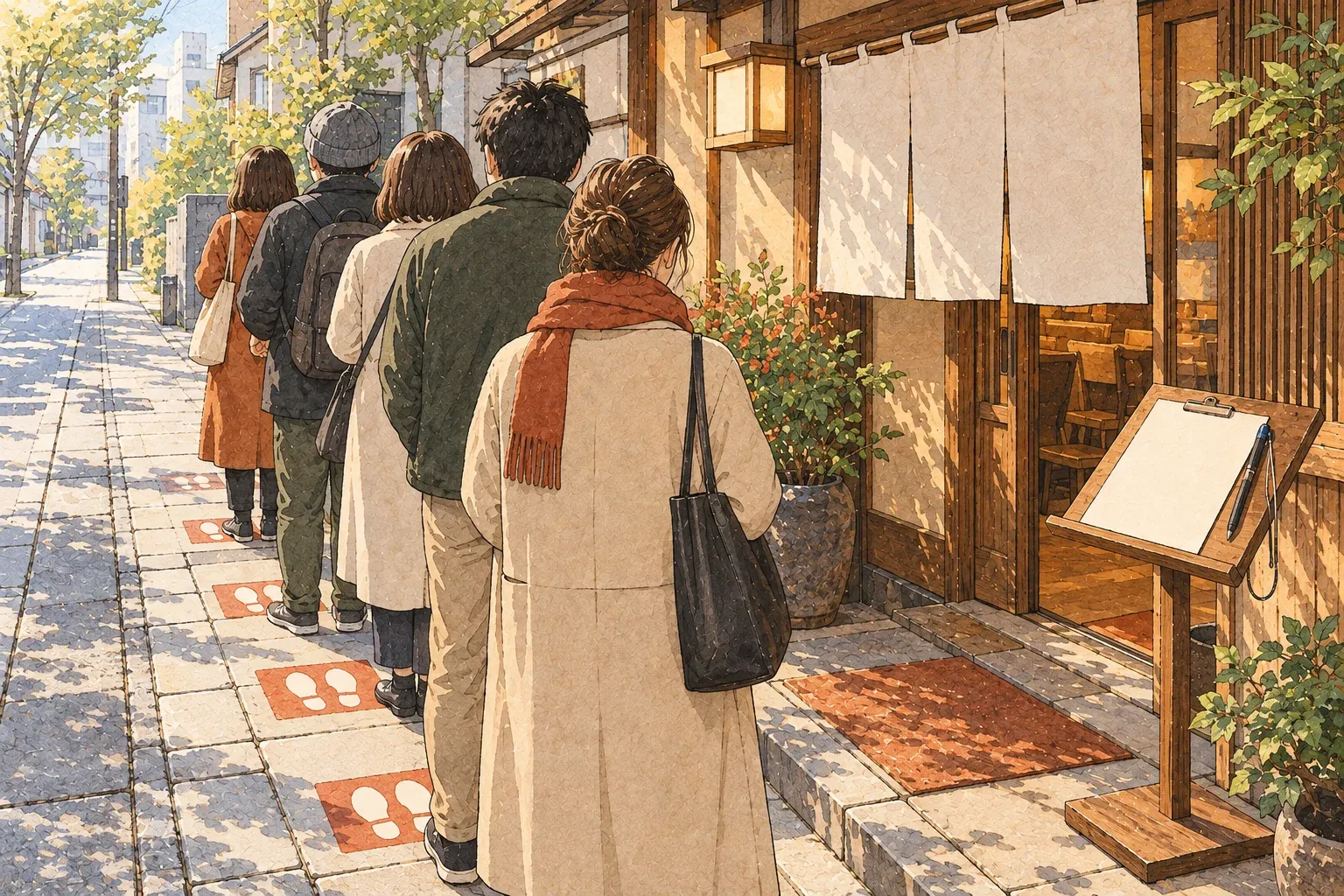
A queue on the pavement outside a small restaurant is one of the first things many visitors notice in Japan. What happens in that queue, and once you are inside, is fairly simple. Why it happens is less well documented than you might expect. This column sets out what the official tourism sources and a few restaurants’ own pages say, and is plain about what I could not find.
The queue
Japan’s national tourism organisation (JNTO) puts it directly in its responsible-travel guide: “People line up for everything in Japan—trains, checkouts, restaurants, store openings, and more.” It adds that “no one cuts ahead”, however long the line, and that you follow any signs or floor markers showing where to stand.
Tokyo’s official tourism site describes the restaurant side. At a full or popular restaurant you may be asked to wait; “In Japan, lines move in order”, and you follow the staff’s directions. JNTO’s page on reservations adds that fast food, family restaurants and ramen shops usually serve on a first-come, first-served basis.
Why people queue for ramen. JNTO’s ramen guide says newer shops have raised the standard of ingredients and technique, drawing long lines, and that “a line outside a shop is often a mark of quality.” That is the only reason the official sources give. I did not find an official explanation of how queues relate to seat numbers or turnover, so I do not offer one.
The sheet by the door
Some restaurants keep a sheet near the entrance where you write your name and the number in your party, then wait to be called. Tokyo’s tourism site and JNTO both mention it.
A 2011 press release from Netflowers, a company that sold a queueing system, described paper waiting sheets as the common method at the time, and said customers still had to stand at the shop after writing their name. It was promoting a touch-panel system that called customers on their mobile phones instead. That is a seller’s account from 2011, not a picture of how shops work now. I could not find an official description of a standard system — numbered tickets, name lists, or what happens if you are not there when your name is called — and I could not open the official sites of the large chains to check theirs.
Being seated
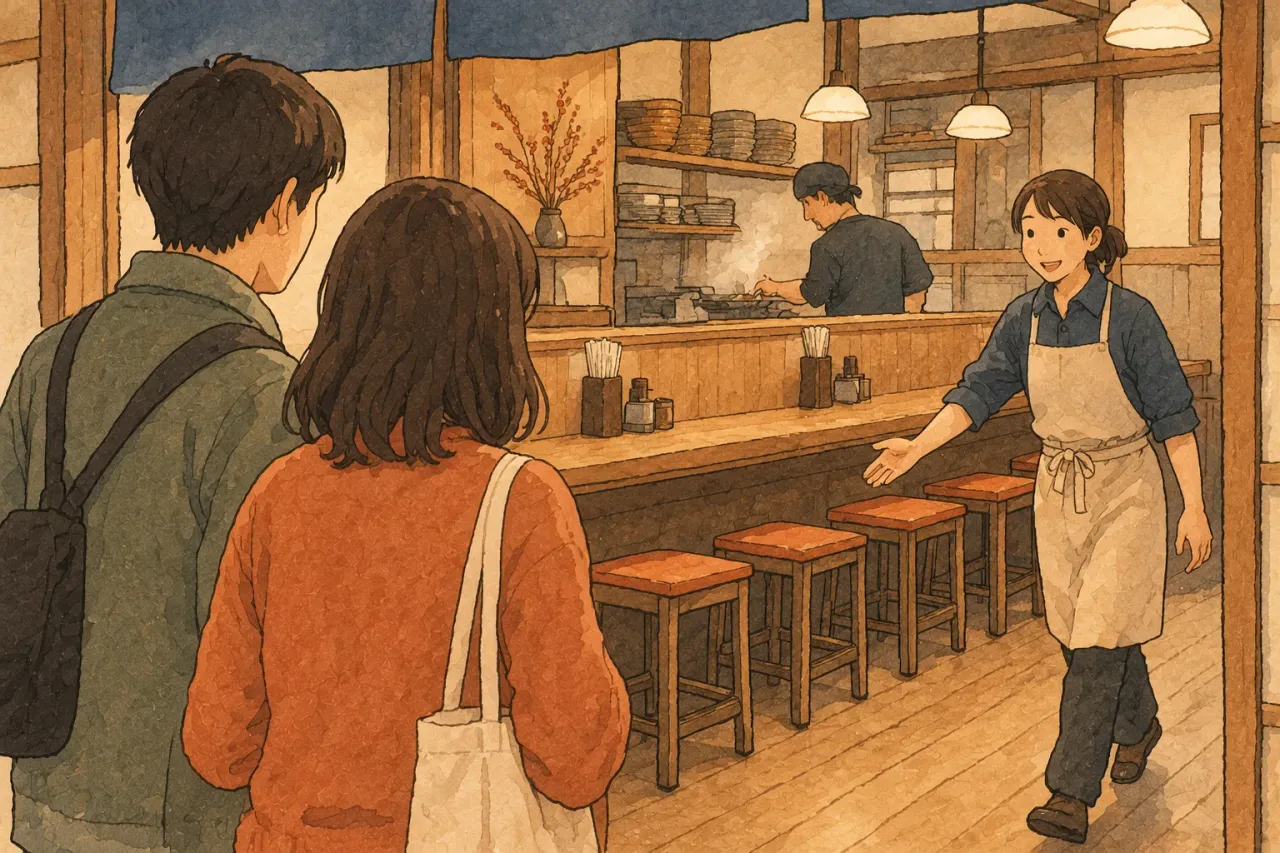
Tokyo’s tourism site says that even if you can see an empty seat, it is usual to wait until staff show you to one. Some restaurants seat a group only once everyone in it has arrived. If staff tell you to sit anywhere you like, you choose.
At ramen shops with a ticket machine by the door, you buy your ticket before sitting; that sequence has its own column on meal ticket machines.
How long to stay
At ramen shops. JNTO’s ramen guide is direct: “Ramen shops are not places to linger over your meal”, and “don’t stay too long after finishing your meal.” It gives no reason, and I do not supply one.
Time limits on tables. Some restaurants set a time limit, and say so on their booking page. Two examples, both on TableCheck and both undated:
- RIGOLETTO WINE AND BAR, Marunouchi: lunch bookings (up to 15:00) are 90 minutes on weekdays and 2 hours at weekends and on public holidays; dinner for five or more is 2 hours 20 minutes. The page adds that seating time may be limited depending on how busy it is.
- cafe wall: at busy times, 90 minutes for lunch and 2 hours for dinner.
JNTO’s reservations page says that some restaurants limit tables to about two hours, and suggests checking before you book if you want to stay longer. Neither restaurant’s page gives a reason for its limit. Not every restaurant has one, and I found no figures on how many do.
Shared tables and counters
I set out to cover aiseki, sharing a table with strangers, and could not. The JNTO pages on food etiquette, manners and responsible travel, and Tokyo’s dining guide, do not mention shared tables or how counter seats are handled, and I did not find a restaurant’s own notice about them. So this column says nothing about them beyond that.
What Japanese diners do
Within what the sources describe: they join the line and wait their turn, write their name where there is a sheet, wait to be shown a seat, and keep to a time limit where the restaurant has one. These are descriptions from JNTO and Tokyo’s tourism site of what is expected, not surveys of how people behave.
What people get wrong
- “An empty table means you can take it.” Wait to be shown, unless staff say otherwise.
- “Every restaurant has a two-hour limit.” Some do, and say so when you book; many say nothing.
- “The queue is about turnover.” I found no official source saying so. JNTO says a line is often a sign of quality.
- “There is a standard waiting system.” A paper sheet is common in the sources; I found no official standard.
Questions people ask
How do queues work outside Japanese restaurants?
JNTO says lines in Japan are orderly and nobody cuts ahead, and that you follow any signs or floor markers. Tokyo’s tourism site says some shops keep a sheet by the entrance where you write your name and the number in your group.
Can I sit at an empty table when I walk in?
Tokyo’s tourism site says it is usual to wait to be shown to a seat even if you can see one free. If staff say you may sit anywhere, you can choose.
Is there a time limit on tables?
At some restaurants. Two Tokyo restaurants’ booking pages list 90 minutes or 2 hours at busy times, and JNTO notes that some places limit tables to about two hours. Not every restaurant does this, so check when booking.
Will I be asked to share a table?
I could not confirm how shared tables or counter seating are handled. The JNTO and Tokyo tourism pages I read do not mention them.
Sources
Prices are in Japanese yen. Conversions are approximate, at ¥177.30 to the euro and ¥158.23 to the US dollar as of 20 Oct 2026. Rates come from the European Central Bank, which publishes on working days only. Prices checked Oct 2026. What food costs in Japan →