
Paying at Japanese restaurants: cards, cash-only places, when you pay and splitting the bill
I have not been to every place in this guide. The figures below are taken from the sources listed at the end, with the date each one was published — not measured by me. Where I have been, the article says so.
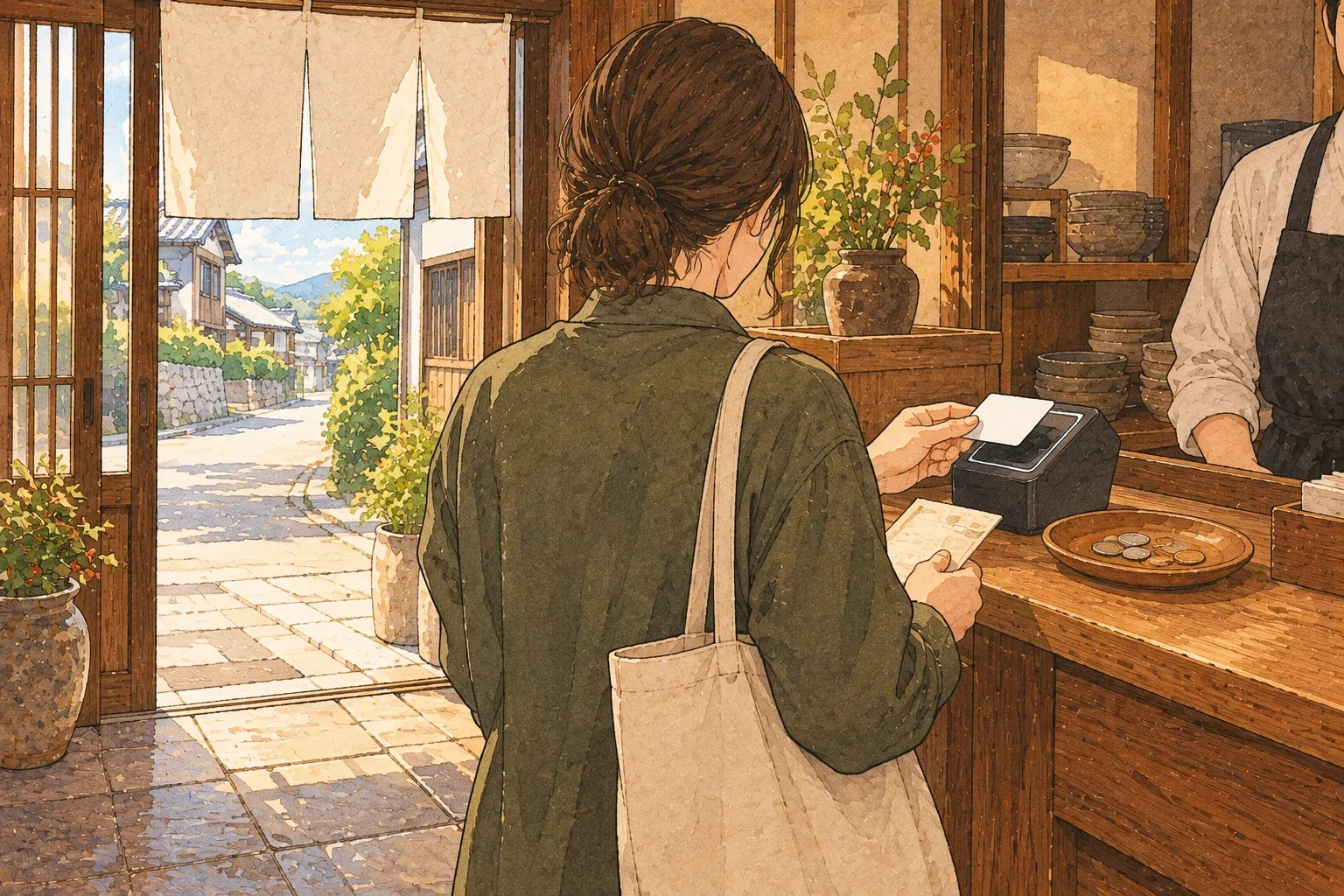
Paying for a meal in Japan raises four practical questions: will they take my card, do I pay at the table or at the till, how do we split it, and do I tip. The official sources answer the first three only partly — paying by card is now the majority of spending in Japan overall, yet cash-only places remain, and how you pay is left to each restaurant. This column sets out what the sources say.
Three related topics have their own columns: how tax-included prices and service charges work, and why there is no tipping (reading menu prices); paying first at a ticket machine (meal ticket machines); and customs at the table itself.
How much of Japan pays without cash
The economy ministry (METI) published its figure in March 2026: in 2025, cashless payments made up 58.0% of spending (¥162.7 trillion). Of that cashless total:
- credit cards 82.7% (¥134.6 trillion)
- code payments, such as QR codes, 10.2% (¥16.6 trillion)
- electronic money 3.7% (¥6.0 trillion)
- debit cards 3.4% (¥5.5 trillion)
What the number measures. It is based on household consumption as a whole, not eating out. I found no official figure for restaurants alone, so “about 60% of restaurant bills are paid without cash” is not something the data says.
A new measure. Having met its target of about 40% by 2025, the government in December 2025 set a long-term goal of 80% and an interim goal for 2030 of 65% on a new domestic measure (55% on the international comparison measure). The ministry explains that the international measure counts about ¥57 trillion of imputed rent on owner-occupied homes — around 17% — in its base, so it created the domestic measure, which ran 8 to 9 points higher over 2020–2024. The 58.0% is the domestic figure. The 2025 figure on the older international measure was not on the page I read. The page does not give reasons for promoting cashless payment, and I do not supply them.
Cards, phones and cash
JNTO’s pages describe the situation for visitors:
- Cards. Generally accepted at major hotels, department stores, large shopping centres and restaurants in cities. International-brand cards can be used broadly across the country, but some shops do not display the cards they take, so check before paying.
- Cash only. Some places, mainly in rural areas, still take only cash, and that includes some hotels. Small shops and guesthouses may be cash only. JNTO suggests carrying yen, and checking with your accommodation before heading to rural or less-visited areas.
- Phone payments. Apple Pay, Google Pay, Alipay and similar services may not work in Japan. Widely used services include PayPay, LINE Pay, Rakuten Pay and Merpay. JNTO suggests carrying cash in case a payment fails.
- Transport IC cards. Suica, PASMO and similar cards can be used at participating shops across the country; they can be topped up only with cash.
JNTO gives no reason why cash-only places remain beyond saying where they tend to be.
Fukuoka’s food stalls. The city’s official tourism site says most yatai take only cash; about one in ten accepts cards.
Where visitors have trouble. In the Japan Tourism Agency’s survey of foreign visitors (4,110 responses, 18 November 2025 to 13 January 2026), 10.7% named using credit or debit cards as a problem during their trip, and restaurants were the most common place it happened, at 32%. The page does not give figures for cash.
When and where you pay
Tokyo’s tourism site says it varies: some restaurants take payment at your seat, and at others you take the bill to a register near the entrance. If unsure, ask. I found no official explanation of why it differs, or a breakdown by type of restaurant.
At ramen shops and others with a ticket machine, you pay first, before sitting.
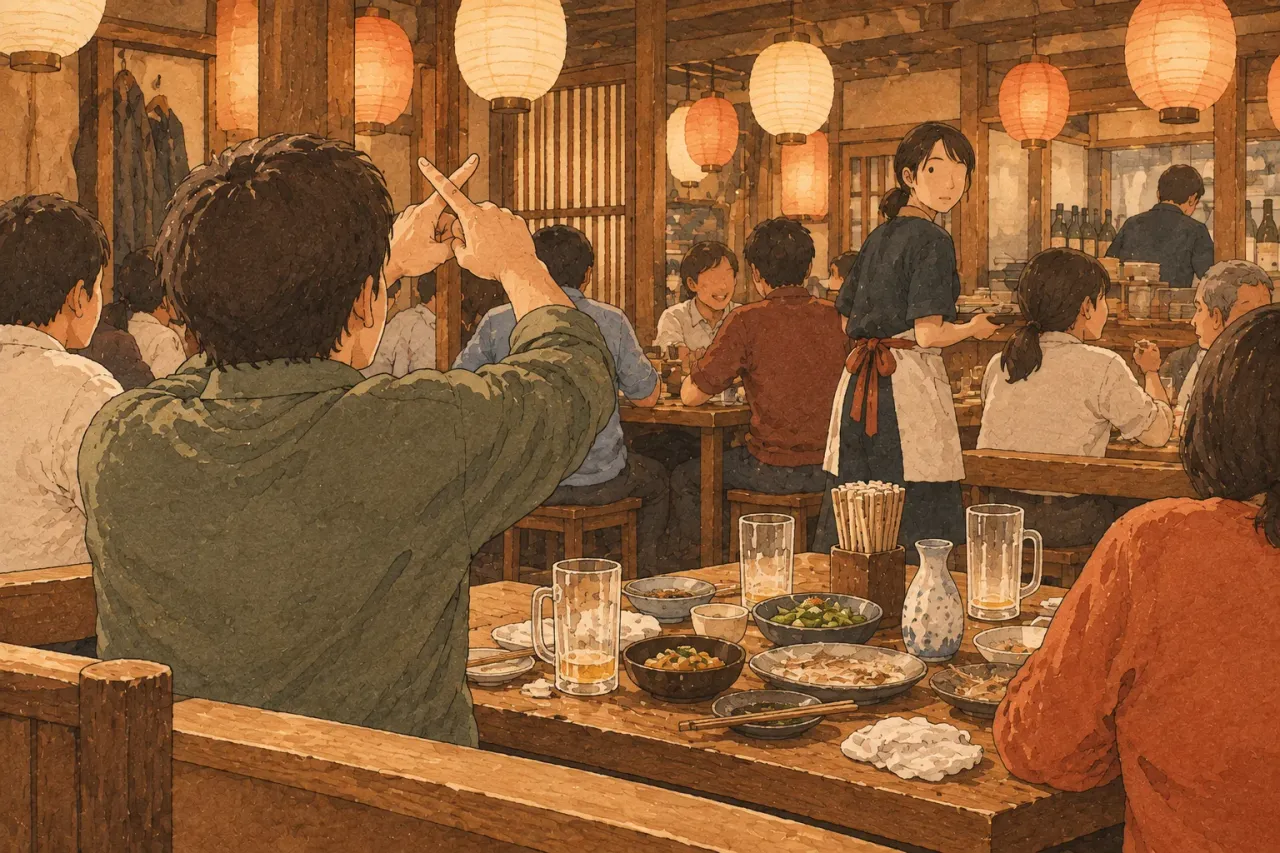
Asking for the bill. Tokyo’s izakaya guide says you can say okaikei onegai shimasu (“the bill, please”) or make a cross with your index fingers, and the bill is brought to the table.
At izakaya. The small starter dish, otoshi, is normally charged per person, Tokyo’s tourism site says. The izakaya overview covers it.
An older note to restaurants. A 2008 tourism manual for businesses suggested briefly explaining how Japanese restaurants work to foreign guests on the menu or elsewhere: tax, no tipping, the charge for the starter dish, and whether you pay at the table or at the cashier. It is a 2008 document; I do not know how many restaurants do this now.
Splitting the bill
Tokyo’s izakaya guide says an itemised bill is rarely given, so groups often divide the total equally. That is as far as the source goes. I found no official guidance on whether restaurants will bill each person separately.
Tipping
JNTO says tipping is not customary for bars, cafés, restaurants, taxis or hotels, and its FAQ says to pay the amount on the bill. Tokyo’s tourism site says service is usually already included in the bill, so there is no need to tip, though giving something as special thanks is up to you. The column on menu prices covers the exceptions, such as guides and interpreters, and how service charges are added. Neither JNTO nor Tokyo’s site gives a cultural or historical reason for the custom.
What people get wrong
- “Japan is a cash society.” Cashless payment made up 58.0% of spending in 2025, by the ministry’s domestic measure.
- “So I will never need cash.” JNTO says cash-only places remain, mainly in rural areas, and most Fukuoka yatai take only cash.
- “My usual phone wallet will work everywhere.” JNTO says some foreign payment apps may not.
- “Wait at the table for the bill.” At some restaurants you pay at the register.
- “Leave a tip.” It is not customary.
Questions people ask
Can I pay by card at restaurants in Japan?
Often, but not everywhere. JNTO says cards are generally accepted at restaurants in cities, while some places, mainly in rural areas, still take only cash. Some shops do not display which cards they take, so check before paying.
Do I pay at the table or at the till?
It depends on the restaurant. Tokyo’s tourism site says some take payment at the table and others have you take the bill to a register near the entrance. If unsure, ask the staff.
How do groups split the bill?
Tokyo’s tourism site says itemised bills are rarely given at izakaya, so groups often divide the total equally. I found no official guidance on whether restaurants will bill people separately.
Should I tip?
No. JNTO says tipping is not customary at restaurants, and to pay the amount on the bill. The column on menu prices covers this and service charges in more detail.
Sources
Prices are in Japanese yen. Conversions are approximate, at ¥177.30 to the euro and ¥158.23 to the US dollar as of 20 Oct 2026. Rates come from the European Central Bank, which publishes on working days only. Prices checked Oct 2026. What food costs in Japan →