
At the Japanese table: itadakimasu, the hand towel, shared plates and lifting your bowl
I have not been to every place in this guide. The figures below are taken from the sources listed at the end, with the date each one was published — not measured by me. Where I have been, the article says so.
A few things happen at almost every Japanese meal: words before and after, a damp towel at the start, dishes shared from the middle, and bowls lifted to the mouth. Visitors often meet them as rules. The official sources mostly describe them as customs with reasons, and this column sticks to what those sources say.
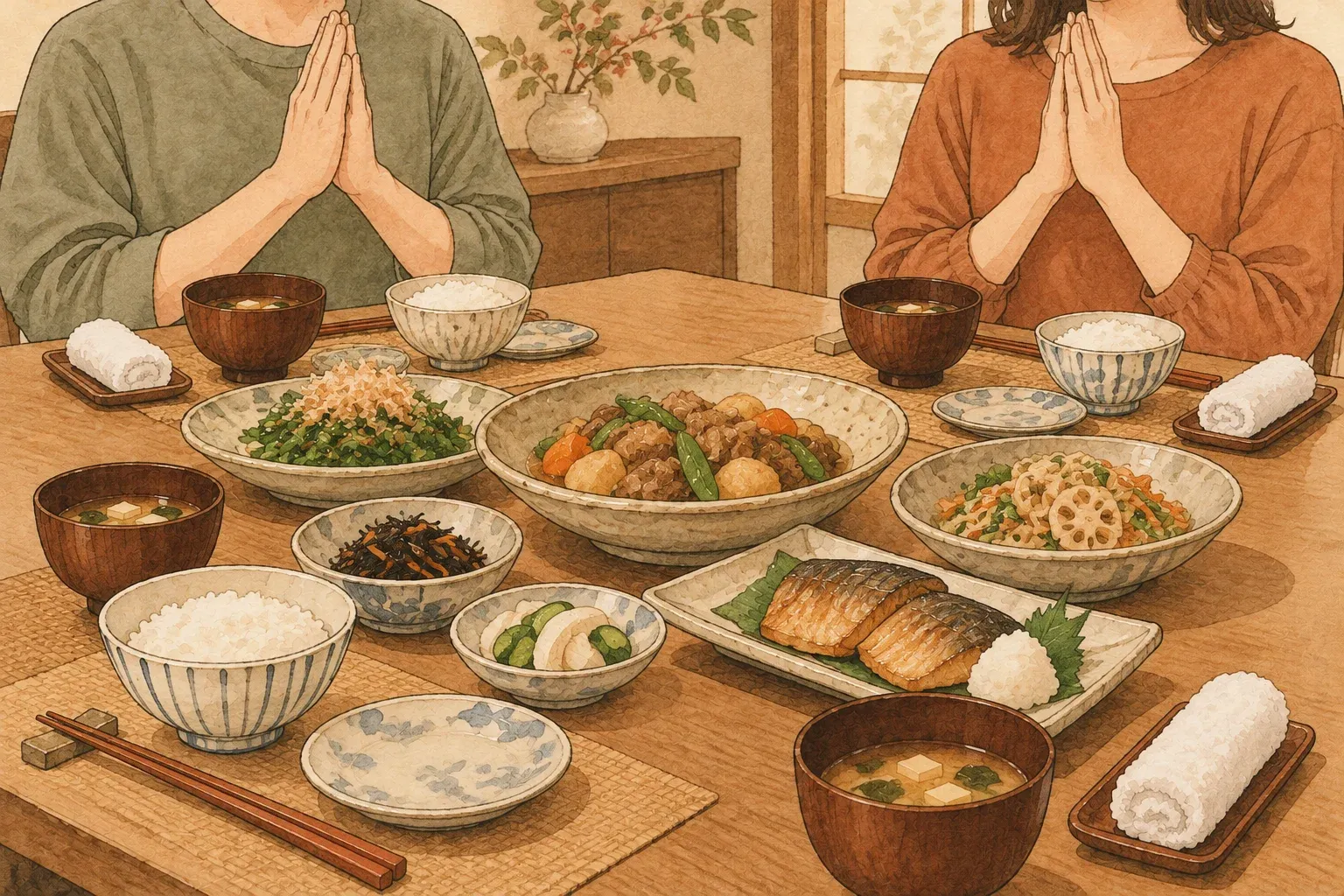
Before and after: itadakimasu and gochisōsama
JNTO explains itadakimasu, said before eating, as meaning something like “I am glad to receive this meal”. Tokyo’s tourism site says adding gochisōsama deshita after the meal conveys gratitude.
The farm ministry goes further. Itadakimasu originally expresses thanks for the gifts of nature that became the ingredients. Gochisōsama thanks not only the person who cooked but those who grew the rice and vegetables, caught the fish, and everyone involved in bringing the food to the table — a way of feeling it that the ministry links to a country surrounded by sea and rich in mountain forests. The ministry’s page does not discuss the words’ etymology, so neither do I.
Learned at school. The farm ministry’s washoku guidebook gives the example of school lunches in Sanjō, Niigata, where everyone says itadakimasu and gochisōsama together, and the meaning is taught as part of food education.
The hand towel
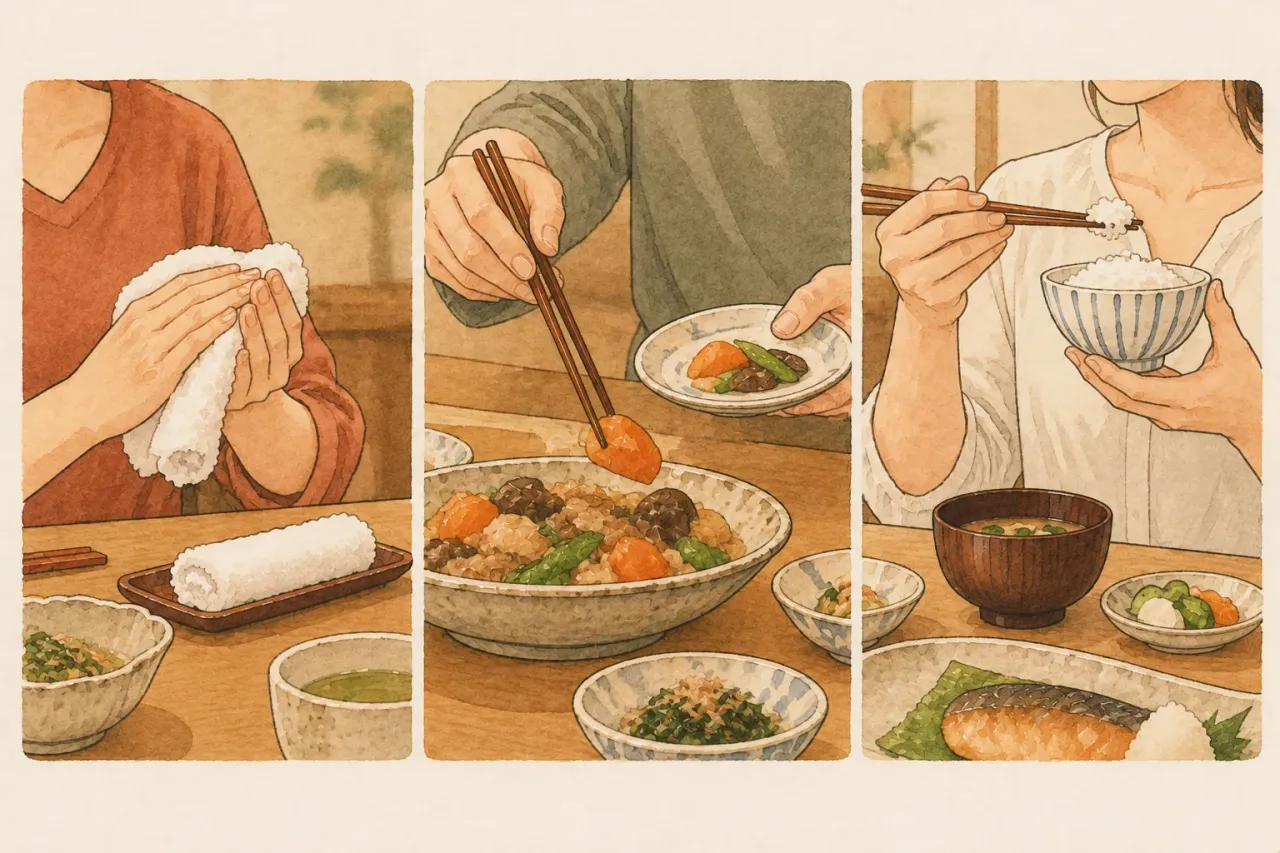
A JNTO blog post: when you sit down you are given a damp towel or wet paper, the oshibori, to wipe your hands and freshen up; afterwards, put it on its tray and you can use it again. I could not reach the towel-rental trade’s own sources, so I give no history.
Shared dishes
- Take to your own plate. JNTO says not to eat straight from a shared platter but to take food onto your own small plate first.
- Use the serving chopsticks where there are some; the farm ministry distinguishes them from your own.
- Wait and ask. JNTO says platters are quite common at group meals; don’t start until everyone has been served, and it is good manners to ask before taking the last piece.
The sources give the steps, not reasons, so I add none.
Lifting the bowl
- Tokyo’s tourism site: picking up small bowls and dishes to eat is the norm, is not bad manners in Japan, and gives an impression of eating carefully. Cupping a hand under food instead of lifting the bowl is the bad form.
- JNTO’s blog: hold the rice bowl and take rice with chopsticks — polite, and sensible, because it stops food dropping. JNTO’s guide: bring the dish to your mouth, not your mouth to the dish.
- Why bowls are lifted. The farm ministry’s explanation is historical: once spoons fell out of use after the Nara period, hot soup was drunk by holding the bowl and sipping, which lacquered wooden bowls allow because they do not conduct heat.
I found no official line on which dishes may be lifted and which may not.
Soup. The farm ministry’s magazine says that when drinking soup, use the chopsticks to hold back the ingredients, and don’t point the tips outward; if drinking only the broth, you may leave the chopsticks on their rest. A JNTO blog post says making a noise when drinking miso soup is fine, as with noodles.
How the tray is laid out
The farm ministry’s layout: rice on the left, soup to its right; the main dish (grilled fish, say) behind the soup, a side dish behind the rice; small bowls between rice and soup, which it says is easy to eat from and looks neat. A whole fish lies with its head to the left. Each dish gets its own plate so flavours do not mix — a courtesy to the eater. The ministry does not explain why rice is on the left, and I found no official source for the usual explanations.
How to eat across it. The ministry says the proper way is always to take rice between mouthfuls of side dish or soup; its guidebook calls alternating staple and side dishes, balancing them in the mouth, a way of eating unique to washoku. It also says that because rice is the centre, Western dishes such as potatoes and croquettes have been absorbed as “side dishes”.
Many vessels. The guidebook notes rice bowls, soup bowls and flat plates for fish, and says few countries use such a variety of tableware — not unrelated, it suggests, to Japan’s distinct seasons.
After the meal. Tokyo’s tourism site says to leave the dishes as they are, not stacked.
What people get wrong
- “Lifting your bowl is rude.” In Japan, the tourism sources say, it is the norm and looks careful.
- “Itadakimasu means ‘let’s eat’.” The farm ministry describes it as thanks for nature’s gifts.
- “Eat straight from the shared plate.” Take to your own small plate first.
- “Stack your dishes to help.” Tokyo’s site says to leave them as they are.
Questions people ask
What does itadakimasu mean?
JNTO renders it as something like "I am glad to receive this meal", said before eating. The farm ministry says it expresses thanks for the gifts of nature that became the food, and that gochisōsama, said after eating, thanks everyone involved, from the cook to the farmers and fishermen.
Is it rude to lift my bowl?
No. Tokyo's tourism site says picking up small bowls to eat is the norm and gives an impression of eating carefully. JNTO says holding the rice bowl is polite and sensible, since it stops food dropping. Bring the dish to your mouth, not your mouth to the dish.
Can I slurp miso soup?
A JNTO blog post says making a noise when drinking miso soup is fine, as with noodles.
What do I do with the hand towel?
Wipe your hands with it. JNTO says it is to freshen up, and that you can leave it on its tray afterwards to use again.
Sources
Prices are in Japanese yen. Conversions are approximate, at ¥177.30 to the euro and ¥158.23 to the US dollar as of 20 Oct 2026. Rates come from the European Central Bank, which publishes on working days only. Prices checked Oct 2026. What food costs in Japan →