
Food souvenirs from Japan: where to buy them, how to read the date on the box, and what you can take home
I have not been to every place in this guide. The figures below are taken from the sources listed at the end, with the date each one was published — not measured by me. Where I have been, the article says so.
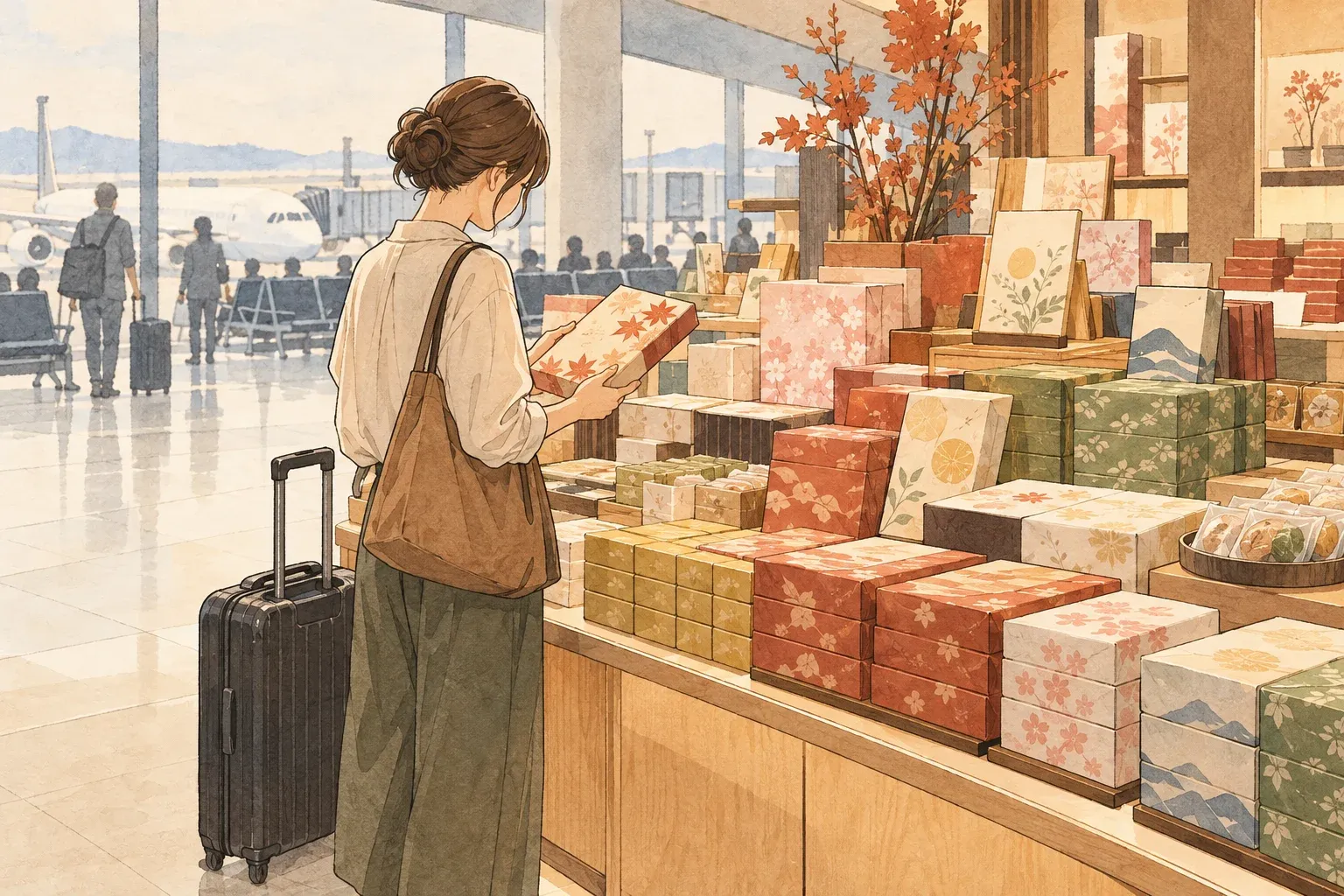
Boxes of sweets, crackers and jellies fill the shops at Japanese stations and airports. This column sets out what the official sources and the makers’ own pages say about buying food souvenirs (omiyage): where JNTO suggests buying them, what two well-known sweets say about themselves, how to read the date on the box, and what the rules say about tax-free shopping and taking food home. It gives no prices; I could not confirm a tax-inclusive price on any maker’s site.
Where JNTO suggests buying them
JNTO’s souvenir guide calls the airport “an ideal place” to buy gifts for friends and family, since you do not have to carry them around for the rest of your trip. It explains the rows of boxed sweets, crackers and jellies by saying Japan has a “regimented gift-giving culture”. For travellers short on luggage space, it suggests things that are small, sturdy and nicely packaged, such as tea, small dolls and stationery.
Its examples by airport:
- Narita Terminal 1: Japanese-patterned cloth, sweets, tea and lacquerware.
- Haneda: Tokyo Pop Town on the fifth floor, before security, mostly anime goods.
- Kansai: umeboshi (pickled plums), which it describes as a Wakayama speciality, and sweets shaped like takoyaki and okonomiyaki.
You may read that Japanese people hand out individually wrapped sweets to colleagues after a trip. I could not find an official source on that custom, and JNTO’s page does not name anyone beyond friends and family, so this page does not describe it.
Two famous sweets, in their makers’ words
Akafuku (Ise). The company’s history page says it was founded in 1707. It records that in 1877 the main shop was rebuilt after flood damage from the Isuzu River, and credits Chie, wife of the sixth owner, with reviving the business. In 1911, it says, Empress Dowager Shōken took a liking to Akafuku mochi, and a special version made with white sugar, instead of the usual brown-sugar bean paste, was presented to her; this was then sold as “Homare no Akafuku” and is regarded as the origin of today’s Akafuku mochi. Later entries:
- 1978: tsuitachi-mochi, sold on the first day of each month, launched.
- 1993: Okage Yokochō opened.
- 2007: in its 300th year, the company was ordered to suspend confectionery production under the Food Sanitation Act and closed; it reopened in 2008.
- 2025: it announced it would start using freezing technology in producing Akafuku mochi.
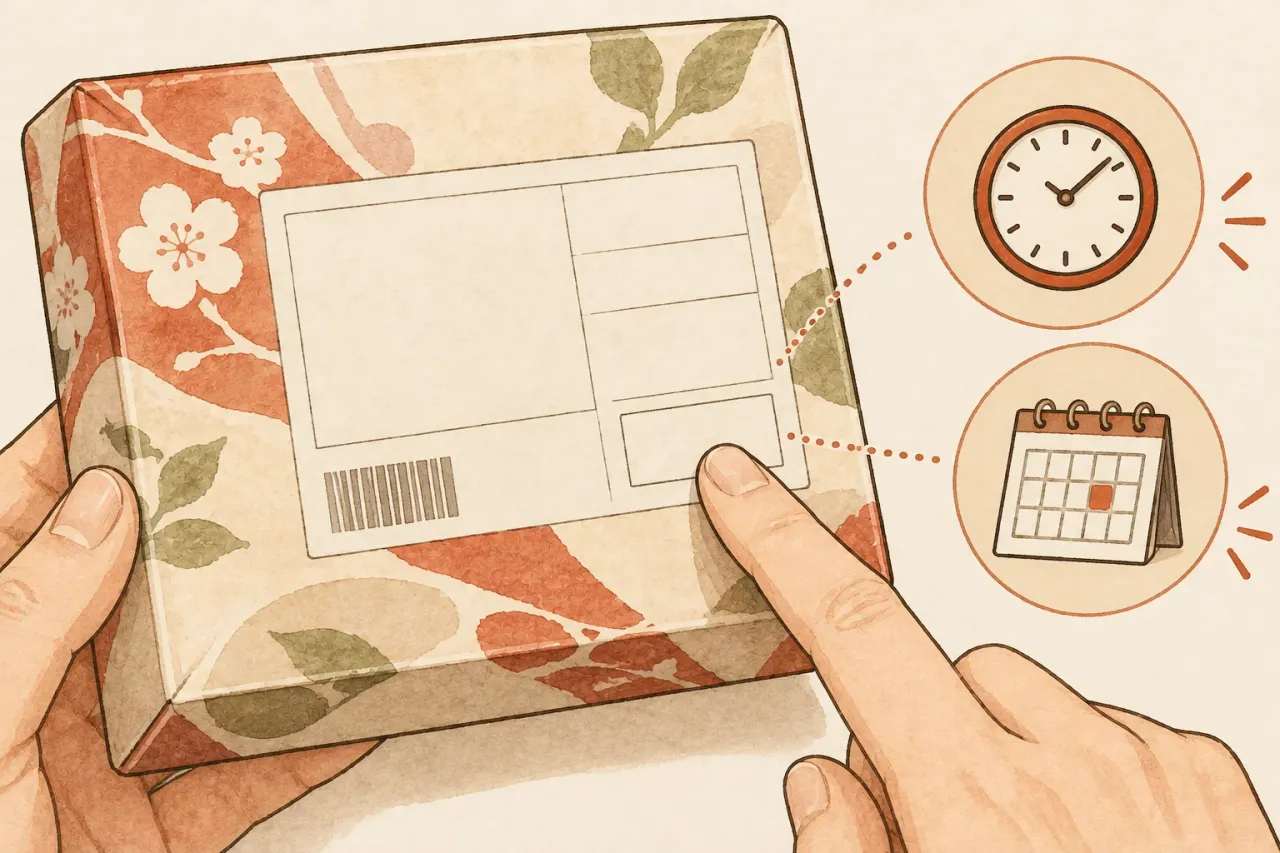
The page says the date of manufacture is printed on the side of the box. It does not say how many days the mochi keeps.
Hagi no Tsuki (Sendai). The maker, Kashō Sanzen, describes it as a Sendai sweet shaped after the full moon over the Miyagino plain: house-made custard cream wrapped in soft sponge cake. Its product page says it keeps at room temperature and uses an oxygen absorber, but gives no number of days, no launch year and no list of where it is sold.
Shiroi Koibito. I could not confirm the launch year, shelf life or price from the maker, Ishiya. Its home page shows a 50th-anniversary photo contest, but its history and product pages did not open when I checked.
Reading the date on the box
Japanese food carries one of two date labels. The Consumer Affairs Agency defines them under the food labelling standard:
- Use-by date (消費期限, shōhi kigen). The date until which, stored as directed, the food is not likely to become unsafe through spoiling or other deterioration. The agency’s examples are foods that go off quickly — boxed lunches, sandwiches, prepared side dishes. Its guidance is that it is better not to eat them after the date.
- Best-before date (賞味期限, shōmi kigen). The date until which, stored as directed, all the expected quality can be kept — with the note that the quality may still be kept after that date. Its examples are foods that deteriorate more slowly — sweets, cup noodles, canned food. It describes this as the date by which food can be enjoyed at its best, and says it may still be edible afterwards.
Who sets the date. The agency says these two labels replaced the earlier date-of-manufacture label in 2003. Industry guidelines for setting them rest on a joint notice from the health and farm ministries in February 2005. Dates are set from objective tests — chemical, microbiological and sensory — and the basic approach is to multiply by a safety factor below 1, setting the date on the short side. The agency’s page on date labels says dates are to be set on a scientific and rational basis.
So for a box of sweets, the date is set by the maker. I could not find the number of days for any of the sweets above on their makers’ pages.
Tax-free shopping, from 1 November 2026
From purchases made on or after 1 November 2026, Japan’s tax-free shopping for visitors moves to a refund system, according to the tourism agency and the National Tax Agency. Until 31 October 2026 you buy at the tax-free price in the shop; from 1 November you pay the price with tax and get the tax back after a customs check when you leave. The National Tax Agency says there is no period when both systems apply. The wider changes are set out in new travel rules and charges in Japan.
The requirements, as the tax agency and the tourism agency give them:
- Who. Visitors staying as Temporary Visitors (short-term stay) and some other non-residents; Japanese citizens qualify only if they have lived abroad for two years or more.
- How much. At least 5,000 yen before tax at one shop on one day, with no upper limit. The old separate limits for consumables (up to 500,000 yen) end.
- How many. Only as much as you can carry out of Japan yourself when you leave.
- Not covered. Gold and platinum bullion and coins, and goods that are exempt from consumption tax.
The tourism agency’s guide for travellers describes the new flow:
- Pay the tax-inclusive price (at least 5,000 yen before tax per shop per day).
- When leaving Japan, within 90 days of purchase, show your passport at a terminal at the airport or port for a customs check.
- The consumption tax amount is refunded. At Narita, Haneda, Kansai, Chubu, Fukuoka, New Chitose and Naha, the procedure can also be done online through Visit Japan Web.
What this means for food. The guide says the special sealed packaging for consumables will be abolished, but if food, drink, cosmetics or other consumables are consumed in Japan, the refund cannot be given. If you have eaten or drunk any of them before leaving, so that some are no longer with you, do not go through the tax-free procedure; tell the customs officer instead. You must have all the items with you at the check, and it cannot be done once they are in checked baggage. If even one item from the same receipt is missing, none of the items on that receipt qualify.
Taking food home
Japan’s official sources cover what Japan requires when you leave. They do not cover what your own country allows in, so check that separately. Buying something at a Japanese station or airport does not mean you can bring it into your country.
Meat products. Japan’s Animal Quarantine Service says an export inspection is needed for (1) items for which the destination country requires an inspection certificate, and (2) products from wild animals such as deer, wild boar, quail, pheasant and duck. Its page says export certificates for products from pigs and wild boar have been suspended since 9 September 2018 because of classical swine fever; check the current status on that page. For personal consumption in Singapore, beef and pork products (up to 5 kg each) and eggs in the shell (up to 30) no longer need an inspection from 12 May 2025. It advises asking the animal quarantine office at your departure airport or port early.
On ham and similar products from a supermarket, its souvenir Q&A says some can be taken out if the destination country allows them and its conditions can be met. Dried fish is outside animal quarantine, though the destination’s rules still apply.
Fruit and vegetables. The Plant Protection Station says taking plants out of Japan follows the law of the destination country or region, and some fruit and vegetables need inspection at the station; it has a page for each country. Its page covers plants carried in hand luggage and does not say whether souvenirs are included.
The other direction. If you live in Japan or are returning there, the Animal Quarantine Service says most meat products bought abroad as souvenirs, including processed ones such as ham, sausages and jerky, cannot be brought into Japan, because inspection certificates are hard to obtain. Since 1 July 2020 the penalty for individuals is a fine of up to 3 million yen or up to three years’ imprisonment.
The same name, a different place
I could not find an official or company source comparing taste, price or range between the shops at a sweet’s home town and those in Tokyo department stores or airports. What I can say from the makers’ own pages:
- Akafuku’s shop list shows its shops in Ise, a tea house at a motorway service area (EXPASA Gozaisho, inbound side), and department stores in Nagoya and Osaka. I did not see station or airport shops on that list.
- Hagi no Tsuki’s product page does not list where it is sold.
This is not a claim that one place sells a better version than another.
What people get wrong
- “The best-before date is a safety deadline.” The consumer agency says food may still be fine after the best-before date; it is the use-by date that marks safety.
- “I can eat my tax-free snacks before the flight.” Under the system starting 1 November 2026, food consumed in Japan does not qualify for the refund, and one missing item voids the whole receipt.
- “If it is sold at the airport, I can take it home.” Japan’s rules cover leaving Japan; your own country decides what comes in.
- “Akafuku has always been made the same way.” Its own history describes a change to white sugar in 1911 and an announcement in 2025 about using freezing technology.
Questions people ask
What is the difference between the two date labels on Japanese food?
The consumer agency defines the use-by date (消費期限) as the date until which food is not likely to become unsafe, for things that spoil quickly such as boxed lunches. The best-before date (賞味期限) is the date until which all expected quality is kept, for slower-spoiling things such as sweets, and food may still be fine after it.
Is the airport a good place to buy food souvenirs?
JNTO calls the airport an ideal place to buy souvenirs for friends and family, since you do not have to carry them for the rest of the trip.
Can I get the consumption tax back on food souvenirs?
From 1 November 2026 Japan moves to a refund system. The tourism agency says that if food or other consumables bought tax-free are consumed in Japan, the refund cannot be given, and you need all the items with you at the customs check.
Can I take Japanese ham or sausages home?
Only if your destination country allows it and its conditions can be met, says Japan’s animal quarantine service. Some meat products also need an inspection in Japan before you leave. Check your own country’s rules separately.
Sources
- JNTO「Guide to the Essential Japanese Souvenirs」
- 赤福「沿革」
- 赤福「赤福餅」(店舗一覧)
- 菓匠三全「萩の月」
- 石屋製菓 公式サイト
- 消費者庁「期限表示(消費期限・賞味期限)について」
- 消費者庁「期限表示」
- 観光庁 消費税免税店サイト(旅行者向け)
- 国税庁「輸出物品販売場制度の見直し(リファンド方式)」
- 国税庁「Tax-Free Shopping System will be shifted to the Refund Method from November 2026」(英語リーフレット)
- 国税庁「輸出物品販売場制度に関するQ&A(リファンド方式・概要編)」令和8年4月改訂
- 動物検疫所「肉製品等を海外へ持ち出す場合」
- 動物検疫所「お土産Q&A」
- 動物検疫所「肉製品等を日本へ持ち込む場合」
- 植物防疫所「海外へ野菜や果物を持ち出す際の規制」
Prices are in Japanese yen. Conversions are approximate, at ¥177.30 to the euro and ¥158.23 to the US dollar as of 20 Oct 2026. Rates come from the European Central Bank, which publishes on working days only. Prices checked Oct 2026. What food costs in Japan →