
Eating while walking in Japan: what Kamakura and Kyoto actually ask, and why bins are scarce
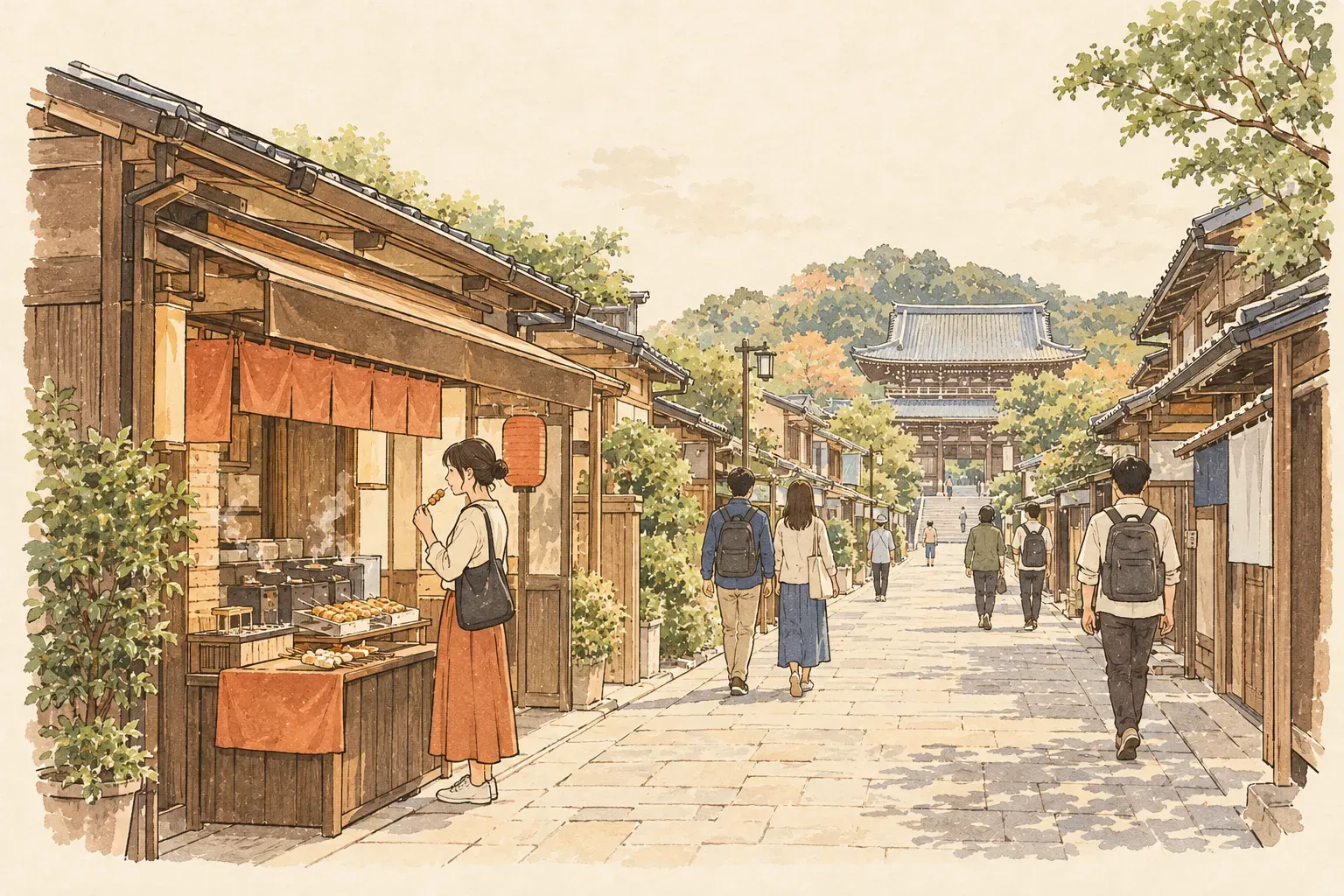
I have not been to every place in this guide. The figures below are taken from the sources listed at the end, with the date each one was published — not measured by me. Where I have been, the article says so.
It is often said that eating while walking is “rude” or even “banned” in Japan. The official picture is narrower and more practical. There is no national rule. A few places with crowded lanes ask people not to eat on the move, for a stated reason — other people’s clothes — and they do it through a city manners ordinance, a market’s notice, or a neighbourhood’s appeal. Separately, rubbish bins are scarce, and the reasons recorded for that are local too.
Kamakura: an ordinance about crowding, not snacks
Kamakura’s ordinance on manners in public places took effect on 1 April 2019. Its list of nuisance behaviour includes “eating while walking or similar, in a narrow or crowded place, in a way that may soil other people’s clothing”. I found no penalty clause in the text.
The city’s own explanation is explicit:
- The ordinance was not made to ban or regulate, and the city does not pursue banning or monitoring as policy.
- A “narrow place” is roughly no wider than two adults can pass in; a “crowded place” is where people touch or nearly touch.
- Manners means conduct that does not cause others unnecessary discomfort.
Why it is written that way. The city’s outline says it began with a 2014 petition about trail runners, but a ban would have been impossible to monitor and enforce, so it chose to address behaviour rather than specific places, city-wide, as a manners ordinance including eating while walking. Littering and smoking in the street are covered by other ordinances that do ban them.
So Kamakura’s rule is not “no eating on Komachi-dōri”. It is “don’t eat on the move where you will brush food against people”.
Kyoto: a market’s request and a neighbourhood’s appeal
Nishiki market. The market’s shopping-street association asks, on its notice page: please refrain from eating while walking through the market; in the crowded market it can cause trouble such as soiling other customers’ clothes; please eat in front of or inside the shop where you bought the food. Kyoto’s tourism FAQ says the market has eat-in spaces. The city’s own page describes the market and a local university making “no eating while walking” posters for every shopfront, and a 2019 leaflet — so the city calls it a ban, the market a request.
Gion. A notice published by Kyoto’s tourism association on 9 January 2024, from residents’ groups in south Gion — the Gion Kōbu Kabukai, the geiko association, Kennin-ji temple and the district council — lists photography and eating among prohibited acts in the area. The city records the district council handing out manners leaflets on Hanami-kōji since 2016. I have not found a Kyoto city ordinance that bans eating while walking in Gion.
The city’s message. JNTO’s report on Kyoto’s tips (March 2025) says to avoid eating while walking in crowded tourist spots, notes that some shrines and temples ban eating, and that smoking in the street and littering are banned city-wide. In February 2026 the city announced in-flight magazine messages asking visitors to hold back from things they do “without thinking”: blocking roads for photos, eating while walking, walking several abreast. Kyoto’s tourism-association code for visitors asks people not to litter, not to leave food, and to check for no-photography signs; it does not mention eating while walking.
Why there are so few bins
There is no single official explanation for Japan as a whole. What the official sources record:
- Kamakura. A 2019 land-ministry report, from an interview with the city, says tourist bins existed until 2014 but were removed in April 2015 when household rubbish collection began to be charged: the city found a lot of household rubbish in them, and removed them for fairness. Stations removed theirs for the same reason. Rubbish left where the bins had been stopped after patrols and signs. Komachi-dōri visitors complain they cannot throw things away at the shop where they bought them; the city asks people to take rubbish home and says littering has not become serious — while doubting that people really carry it all home.
- Ishigaki, Okinawa. The same report says some shops removed their bins because customers did not sort rubbish, and the city worries fewer bins will mean more litter.
- Nationally. An environment ministry casebook (January 2025) starts from “the current situation in Japan, with few bins”, without saying why. In the tourism agency’s survey of foreign visitors (4,110 responses, winter 2025–26), too few bins was the most common problem, at 17.2%, down 4.7 points from the previous survey.
What people actually do
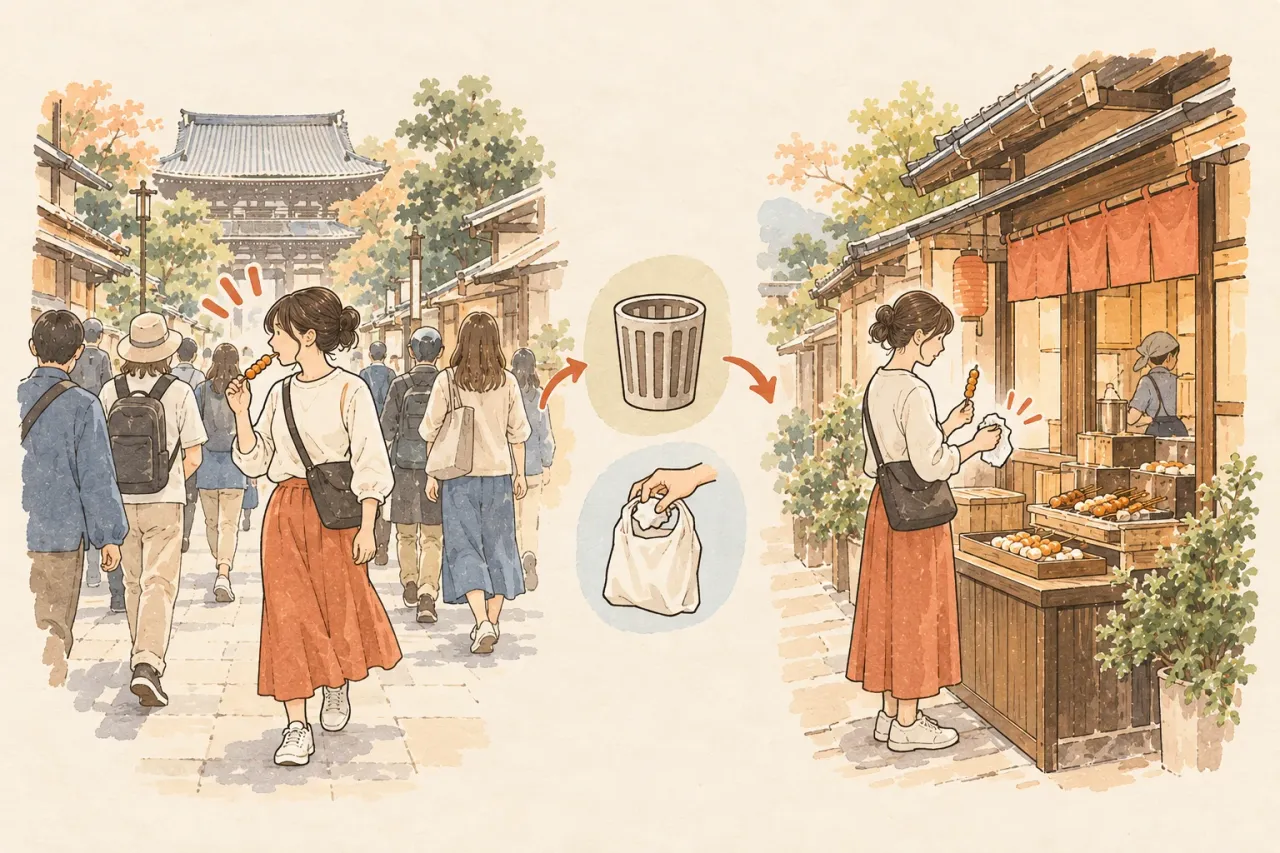
The official sources describe what is asked, not what everyone does: Kamakura asks people to take rubbish home; Nishiki asks people to eat at the shop; Kyoto’s code asks visitors to carry their own bag and bottle and not to litter. I found no official data on how many people follow them.
Takeaway and tax
A takeaway snack is taxed at the reduced rate and eating in at the standard rate, so the same snack can have two prices. See the menu-prices column.
What people get wrong
- “Eating while walking is illegal in Japan.” There is no national rule. Kamakura’s ordinance has no penalty in its text; Nishiki’s is a request.
- “Kamakura banned eating on Komachi-dōri.” Its ordinance is about narrow, crowded places and soiling clothes, and the city says it is not a ban.
- “There are no bins because of one national policy.” The only reasons on record are local, such as Kamakura’s 2015 rubbish-charge change.
Questions people ask
Is eating while walking illegal in Japan?
Not as a national rule. Kamakura has a manners ordinance that names eating while walking in narrow or crowded places, but the city says it was not made to ban or police anything and it carries no penalty in the text. Places such as Kyoto's Nishiki market ask you not to.
Can I eat while walking in Nishiki market?
The market asks you not to. Its notice says eating while walking in the crowded market can soil other people's clothes, and asks you to eat in front of or inside the shop where you bought the food.
Why are there so few bins?
There is no single official reason. Kamakura removed its tourist bins in 2015 when household rubbish collection became paid, because people were dumping household rubbish in them. Too few bins was the top complaint in the tourism agency's survey of foreign visitors, at 17.2%.
Sources
- 鎌倉市 公共の場所におけるマナーの向上に関する条例(条例本文)
- 鎌倉市 同条例の解説
- 鎌倉市「(仮称)観光等マナーの向上に関する条例」素案概要
- 京都錦市場商店街振興組合「お願いとご案内」
- 京都市「外国人観光客等へのマナー啓発の取組等について」
- 京都市「観光マナー啓発・散乱ごみ対策」
- 京都市観光協会 DMO KYOTO「Gion manner」
- JNTO「City of Kyoto introduces tips for manner-minded tourists」
- 京都市観光協会「京都観光モラル」観光客向け
- 京都観光オフィシャルサイト FAQ(錦市場)
- 環境省「観光地におけるごみのポイ捨て・発生抑制対策実績と改善の事例集」
- 国土交通省「環境と観光の両立のための持続可能な観光客受入手法に関する調査業務」報告書
- 観光庁「訪日外国人旅行者の受入環境整備に関するアンケート」
Prices are in Japanese yen. Conversions are approximate, at ¥177.30 to the euro and ¥158.23 to the US dollar as of 20 Oct 2026. Rates come from the European Central Bank, which publishes on working days only. Prices checked Oct 2026. What food costs in Japan →